NEARLY nine years after its passage, the 18th Amendment to the Constitution, and the devolution of powers it oversaw from the centre to the provinces, is still throwing up jurisprudential and legislative questions. Suffice it to say, this should not be the case close to a decade after the passage of the landmark law, as the country’s Constitution is clear on the issue of devolution.
There has of recent been talk — emanating from the ruling party — of the need for a ‘uniform’ education system in the country, even though education is a devolved subject and such a matter needs debate and consensus.
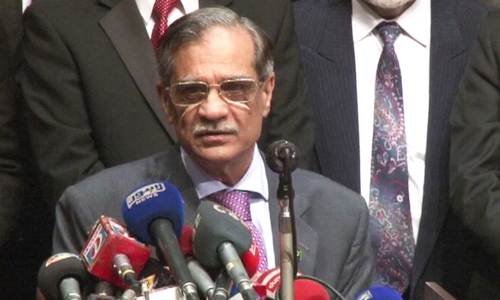
The latest controversy focuses on the status of health, also a provincial subject. On Wednesday, the Supreme Court rejected appeals regarding the ownership of three major Karachi hospitals and ruled that Islamabad would continue to administer the JPMC, the NICVD and the NICH.
The PPP, that rules Sindh, has reacted strongly to the apex court’s decision. Party chief Bilawal Bhutto-Zardari told parliament on Thursday that the decision was an “attack” on the 18th Amendment while within the judiciary, Justice Maqbool Baqar, who was on the bench that was hearing the hospitals’ case, wrote a dissenting note. The judge wrote that throughout the country’s legislative history public health “remained exclusively with the provinces”. This interpretation has especially been strengthened after the passage of the 18th Amendment.
It should also be mentioned that the provincial government was doing a fairly decent job administering the hospitals in question, particularly the NICVD.
The principle of devolution needs to be respected, considering that all federating units and political forces supported the move to devolve powers. Efforts by Islamabad to micromanage subjects clearly resting with the provinces should be avoided.
While the federal government should by all means help the provinces improve their handling of areas such as health and education, there must by no means be an effort to ‘roll back’ the powers, especially through the back door.
Having said that, there remain major provincial capacity issues. Take the case of Sindh: while the tertiary hospitals mentioned above may be showing improvement, the public health infrastructure in the province is in terrible shape and needs a major revamp.
This is especially true if one is to look at the appalling condition of health centres in the rural parts of Sindh. Education is not doing any better, if independent assessments of learning outcomes are anything to go by.
So while the provinces have every right to stake their claim to hard-won subjects, these claims should be accompanied by intentions and efforts to improve the situation. Simply claiming that all is well is not enough. Sindh and the other federating units must show, through demonstrable and visible results in the health, education and social sectors, that they are serious about their constitutional duties.
Published in Dawn, January 19th, 2019