'IHC did not adhere to SC guidelines about bail judgements while deciding Sharifs' petitions'


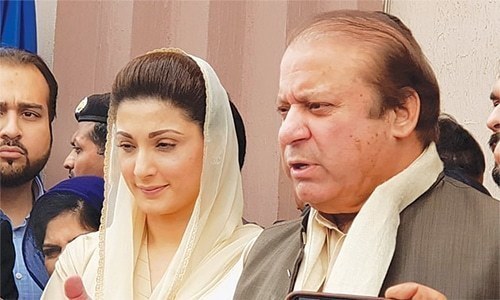
The Supreme Court on Wednesday issued its detailed judgement regarding the rejection of a National Accountability Bureau (NAB) appeal against the Islamabad High Court decision to suspend the prison sentences awarded to former prime minister Nawaz Sharif and his daughter Maryam Nawaz in the Avenfield corruption reference.
A five-member larger bench of the SC had on Monday thrown out the accountability watchdog's appeal challenging the September 19, 2018, IHC order under which Sharif, his daughter and son-in-law retired captain Mohammad Safdar were granted bail after suspension of their jail terms.
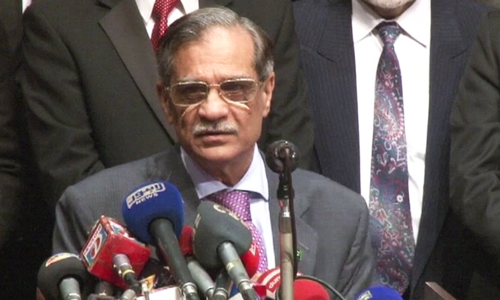
The five-page SC written judgement, penned by Chief Justice-designate Asif Saeed Khosa, while detailing the reasons for dismissal of NAB's appeal has pointed out several flaws in the IHC judgement for suspension of the Sharifs' sentences.
The verdict notes that "instead of adhering to the guidelines issued and recommendations made" by the SC in an earlier case regarding shorter formats of orders to be passed in matters of bail, the high court had issued a 41-page judgement while deciding the Sharif's bail petitions.
According to the judgement, it is a settled principle of law that while deciding an application for bail or the suspension of sentence, the merits of the case are not commented upon in detail. However, the IHC in its impugned judgement "had not only undertaken a detailed assessment of the merits of the case but had also recorded some categorical conclusions regarding the same".
Besides, the Sharifs' writ petitions for suspension of their sentences were taken up at a time when their main appeals challenging the accountability court's verdict in the Avenfield case had already been fixed for hearing. This is in contrast to judicial norms, the judgement said, because sentences are usually suspended considering that a convict "may not be kept in custody till his appeal is fixed for hearing".
Citing previous cases, the written verdict says that the SC has clarified that in cases under the National Accountability Ordinance, 1999 a high court may exercise its constitutional jurisdiction to grant bail "only in extraordinary circumstances and in cases of extreme hardship". But in the cases concerning the Sharifs, "no such extraordinary circumstance or hardship had been referred to" by the IHC in its judgement.
Additionally, the judgement says that by adverting to some deficiencies in the evidence that led to the Sharif's conviction under Section 9(a)(v) of NAO 1999, the high court had failed to consider that conclusions in that regard at the bail stage were "premature" as additional evidence could have been adduced or procured during the pendency of their appeals.
"Despite the above-mentioned deficiencies found by us in the impugned judgments," the verdict reads, "we are cognisant of the legal position that considerations for grant of bail and those for its cancellation are entirely different".
Detailing reasons for the dismissal of NAB's appeal, the SC judgement noted that the bureau had not levelled any allegations of misuse or abuse of the concession of bail by the Sharifs.
In addition, one of the three respondents (Nawaz Sharif) is already in jail after being convicted in another case; a second respondent (Maryam) is a woman and "the law envisages concession for her in the matter of bail"; and the prison sentenced awarded by the trial court to the third respondent (Safdar) was quite short.
In these "peculiar circumstances", the SC bench did not feel persuaded to interfere with the jurisdiction exercised by the IHC in deciding the bail applications. NAB's appeal was thus dismissed.
On July 6, 2018, Judge Mohammad Bashir of the accountability court while deciding the Avenfield apartments reference had awarded 10-year imprisonment to Nawaz Sharif, seven years to his daughter Maryam and one year to his son-in-law Safdar.
Two months later, a division bench of the IHC had accepted their petitions seeking suspension of the sentence and set them free on Sept 19. The judgement was subsequently challenged in the apex court by NAB.