Policy lending to resume after IMF bailout finalised: ADB


 4
4


ISLAMABAD: The Asian Development Bank (ADB) would restore policy lending to Pakistan on the finalisation of a bailout package from the International Monetary Fund (IMF).
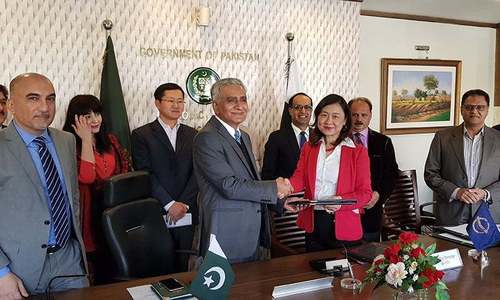
“We need IMF support for policy lending,” said ADB’s country director to Pakistan, Xiaohong Yang, at a joint media interaction with visiting Director General of the ADB Strategy, Policy & Review Department, Tomoyuki Kimura.
Both the World Bank and ADB do policy lending only if the country’s reserves have three or more months of import cover, while Pakistan’s reserves are barely enough for one and a half months.
Ms Yang said the structural reforms were being devised in consultation with other multilateral financial institutions to help Pakistan restore economic stability and overcome macroeconomic imbalances.
The ADB officials said the their institution was preparing strategy to address the circular debt in collaboration with government in a manner that it tackles both the flow of fresh debt and then resolve the outstanding stocks on permanent basis.
Responding to a question about PTI’s new strategy to improve power sector through reforms instead of privatisation, Mr Kimura said that privatisation should be a tool and not an end in itself. He said the ADB had no problem with the government if its ultimate goal was to improve efficiencies and would in fact support those measures.
Regarding ADB’s possible involvement in CPEC, the visiting official said annual infrastructure financing requirement in Asian region stood at $1.7 trillion while ADB’s portfolio was around $20 billion. He said CPEC was a bilateral arrangement between China and Pakistan and the ADB was not meant to support bilateral initiative but had launched Central Asian Regional Economic Cooperation (CAREC) to support regional cooperation and integration that would help Pakistan realise its export potential to the Central Asia and Afghanistan.
Kimura outlined seven-point policy directions of ADB’s new corporate strategy and its importance to Pakistan’s development agenda. “Strategy 2030 enables ADB to better respond to Pakistan’s changing development needs,” said Kimura, adding that ADB shared the new government’s vision to accelerate sustainable and inclusive economic growth by promoting innovative technologies and delivering development solutions through a mix of public and private sector operations.
“ADB supports the country’s agenda of diversifying exports to revitalise the economy and generate jobs,” he said, adding that ADB strategy will provide the framework and tools to tailor development finance, knowledge and partnerships to specific country needs.
Kimura noted Pakistan’s growth prospects and said its strategic location offered vast opportunities to expand regional economic and market integration. The country needs to continue improving key infrastructure, energy supply, domestic resource mobilisation and the cost of doing business to ensure higher levels of competitiveness and productivity, and link up with the global production networks and value chains.
He said Pakistan should resolve structural impediments to economic development through reforms that revive and diversify exports for job creation. “The country needs to improve skills and labour market efficiency; enhance financial inclusion and deepening; promote greater infrastructure, investment, private sector, foreign direct investment and trade integration.”
Under Strategy 2030, ADB will focus on seven operational priorities. First three include addressing poverty and reducing inequalities, accelerating progress in gender equality, tackling climate change, building climate and disaster resilience, and enhancing environmental sustainability. Besides, ADB’s focus would be on making cities more livable, promoting rural development and food security, strengthening governance and institutional capacity and fostering regional cooperation and integration.
Published in Dawn, December 20th, 2018