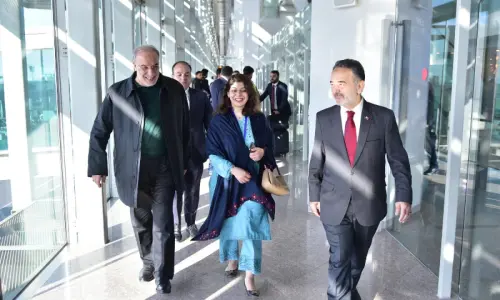
‘Democratic forces’ need to devise joint strategy: Zardari

ISLAMABAD: The Jamiat Ulema-i-Islam (JUI-F) is planning to hold another multiparty conference with representation of all opposition parties in parliament to discuss the prevailing political situation in the country and to devise a joint strategy against the government.
This was disclosed by JUI-F chief Maulana Fazlur Rehman while briefly talking to reporters outside his residence after meeting Pakistan Peoples Party (PPP) leader and former president Asif Zardari who had called on him on Monday evening.
The Maulana said they would invite all the opposition parties in parliament next week to attend the multiparty conference so that they could “devise a joint strategy” against the government that he said had been ruling the country with a “fake mandate”.
Speaking on the occasion, Mr Zardari said that during the past 10 years, they had made every attempt to ensure continuity of the democratic forces in the country, “but now democratic forces seem to be getting weaker". He said the present government was unable to run the country and the democratic forces needed to devise a joint “strategy”.
After a meeting with PPP leader, Fazl says JUI-F plans another conference of opposition parties
Replying to a question about any possibility of moving a no-confidence motion against Prime Minister Imran Khan in the National Assembly, the former president said they first required to assess their parliamentary strength. He added that their main purpose was not to dislodge the government, but to put it on the democratic track. And for this purpose, a discussion could be held among “friends”, he said.
He said presently their [the government’s] actions could not be called democratic.
Responding to a question if he would also invite the Pakistan Muslim League-Nawaz (PML-N) leadership, he simply responded that they were in contact with Maulana Sahab.
The JUI-F chief said that he had met PML-N’s supreme leader Nawaz Sharif in Lahore and later on Sunday he met Leader of the Opposition in the Senate Raja Zafarul Haq. He claimed that there was complete understanding and an agreement among the opposition parties that they should adopt a “joint strategy”.
When a journalist asked as to why the opposition remained disunited at the time of the elections of the president and the prime minister, the Maulana said: “Why are you digging up the past?”
Mr Zardari met the JUI-F chief only a day after calling upon all the political parties to unite on one platform to declare that the Pakistan Tehreek-i-Insaf (PTI) government could not run the country.
He told a news conference after attending a lawyers’ convention on Sunday that a possibility of his meeting with Nawaz Sharif could not be ruled out.
The JUI-F had organised the first multiparty conference having representation of the opposition parties in Islamabad soon after the July 25 general elections. In the multiparty conference, Maulana Fazlur Rehman had suggested that the opposition members should not take oath of the assembly in order to lodge a strong protest against the alleged rigging in the elections.
However, both the PPP and the PML-N did not support the idea and convinced the Maulana that they should use the platform of the parliament to give a tough time to the government.
The JUI-F again hosted a multiparty conference in the first week of August in which the opposition parties agreed on a formula for jointly contesting the elections of the speaker, deputy speaker and the prime minister. However, the formula could not be implemented after the PPP refused to vote for Shahbaz Sharif in the election of the prime minister against Imran Khan after expressing its reservations over his nomination by the PML-N.
Later, the PML-N hosted another multiparty conference in Murree in an effort to reach a consensus on the presidential candidate, but the opposition parties failed to field a joint candidate after which Maulana Fazlur Rehman and Chaudhry Aitzaz Ahsan contested the election against PTI’s Dr Arif Alvi, making the latter’s victory a smooth affair.
Published in Dawn, October 23rd, 2018
Download the new Dawn mobile app here: