Special bench to examine report on missing persons: CJP Nisar


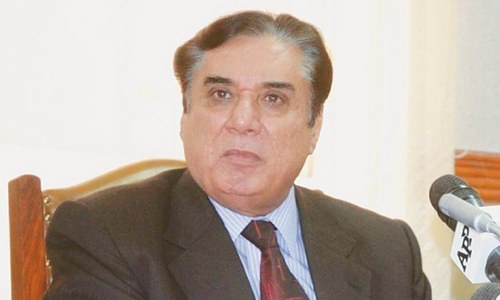
Chief Justice of Pakistan (CJP) Mian Saqib Nisar on Wednesday formed a two-member special bench comprising Justice Manzoor Ahmed Malik and Justice Sardar Tariq to study a report on missing persons' cases submitted in court today by the Missing Persons Commission (MPC).
According to the MPC report, 3,519 cases out of the 5,349 it received in the current year have been resolved. The commission is currently working on the remaining 1,830 cases, the report added.
During the hearing on the missing persons' case today, Justice Nisar said that the court had decided to forward all missing persons cases to the commission.
In the MPC, officers ranking no lower than brigadier level will represent intelligence agencies, while police will be represented by officials no lower than deputy inspector general level.
The CJP informed the court that high-level meetings — that were attended by the director generals of the Inter-Services Intelligence and Military Intelligence — had been held in this regard.
The chief justice said that he had been told that there was a lack of evidence in many cases and therefore, army and police officials would attend commission proceedings.
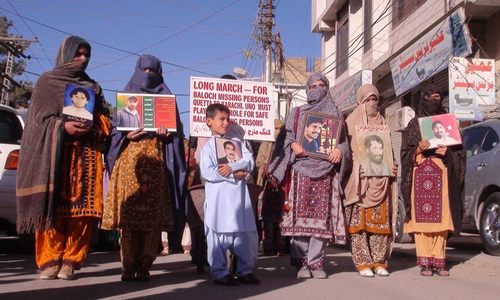
The petitioners, who attended today's proceedings, complained that while the MPC had ordered the release of many persons who had gone missing over the years, none of them had been produced before the commission.
At this point, Falak Naz, who represented the Ministry of Defence, said that the agencies had claimed that they do not hold missing persons whose release had been ordered by the MPC.
Tariq Asad, a lawyer for missing persons, also claimed that the MPC was doing its job but its orders were not being acted upon and missing persons were not produced.
"Why are the missing persons not being produced even though the [commission has] issued production orders?" the chief justice asked.
A Defence Ministry representative responded that the agencies claim that they are not holding the missing persons and don't have any data about them either.
"Are you suggesting that we ignore the evidence and take the agencies' word as final?" Justice Nisar asked. He then added that there were some elements who were trying to defame the intelligence agencies.
Asad, at this point, accused the Counter-Terrorism Department of "picking up people" saying that there are "several reports" that prove his point.
Furthermore, the chief justice will also chair a high-level meeting to watch over the commission's proceedings. The meeting will be attended by heads of all intelligence agencies, inspector generals of all four provinces as well as Gilgit-Baltistan.