It seems that while India and Pakistan exchanged hot words in the latest round of tensions between the two countries, the World Bank was putting the finishing touches to a study whose main conclusion is that both countries have a trade potential of some $37bn if they can find a way to unlock it.
The region has clearly much to gain if, instead of barbs, the two countries traded goods and services. The figures produced by the World Bank is the highest such estimate that we have seen thus far; sadly, it is also apparent that the two neighbours are paying a heavy price for their continuing inability to engage in a productive manner.
For the moment, the high ground rests with Pakistan. It was the government of Pakistan that extended a hand for talks, and the government of India that invoked unreasonable grounds, as well as undiplomatic language, to reject the offer after having accepted it.
But the moral high ground is not enough: Pakistan must bring a solid negotiating position to the table. Given the disparity in size between the Pakistani and Indian economies, simple market access to Pakistan’s domestic market will not be enough to attract sufficient interest from across the border.
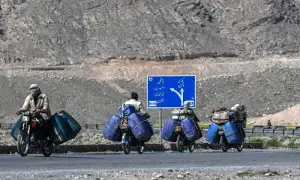
The biggest plum in Pakistan’s offering is transit trade rights to Afghanistan, which were signalled to Delhi as potentially being on the table, though rather late in the game. Beyond that, Pakistan has access to the energy resources of Central Asia and Iran that can be leveraged very effectively once the geopolitics at play to the west are sorted out.
Played smartly, Pakistan can build a far heavier negotiating position than it has currently managed to do, and thereby create an interest where there is little at the moment.
For its part, India needs to learn to live in its own neighbourhood. For decades, we have seen it forge ties of trade and investment with distant countries, while ignoring its own neighbours. As the largest economy in the region, it has to do far more to take up the responsibility for crafting greater regional flows, even if the value chains look more attractive in Southeast Asia.
Coupled with this lack of interest, India is also known for its reliance on non-tariff barriers as a tool to restrict trade. The weakest part of the World Bank’s report is precisely when it comes to addressing this problem, where it refuses to see that the NTBs come and go with circumstances, ie their use as trade barriers appears to be centrally directed.
Instead, the report loses itself in the labyrinthine details of various trade bureaucracies. Nevertheless, the overall thrust of the report is a welcome breath of fresh air in a relationship that has so far been characterised by tense exchanges.
Published in Dawn, September 26th, 2018