0
0

PRESENT-day school and college students would be surprised to know that half a century back there used to be an ‘easy Urdu course’ for the students of ‘English medium schools’ and colleges. But on Sept 24, 1968 the Board of Intermediate and Secondary Education Karachi announced that it had withdrawn the concession of Urdu easy course.
The decision was to be implemented for first year classes from the next academic session (1969-70) and for second year classes from 1970-71. All class XI students from the English–medium schools would thus have to study, what was then called, ‘normal Urdu course’ from the next year. The normal one, by the way, had already replaced the easy one for class X. The easy course could, however, be offered to the students who took their Senior Cambridge or an equivalent foreign exam “until 1972 as a special case, subject to the permission of the board”. (This means that an egalitarian education system has always been a dream, and it seems will remain so.)
Speaking of the Urdu language, a few days ago, one of the most eminent 20th century ghazal poets Ustad Qamar Jalalvi had fallen ill (he had contracted jaundice) and was shifted from his Liaquatabad house to a clinic in Nazimabad. On Sept 25, a media report said the ustad showed gradual signs of improvement. He even chatted with the people — his pupils, admirers, fellow poets and scholars — who came to see him. Sadly, the poet did not survive for long, and passed away eight days later (Oct 4).
Poets and sheaves of papers go hand in hand. But a pretty mysterious thing happened with regard to the latter on Sept 28 when nearly 40 big cases containing personal papers of Quaid-i-Azam Mohammad Ali Jinnah were shifted from the University of Karachi to Islamabad. The papers, which included documents and personal diaries of the Father of the Nation, were recovered from Qasr-i-Fatima after the death of the Madir-i-Millat, Mohtarama Fatima Jinnah, and were subsequently handed over to the university in order for them to be preserved. The documents were fumigated and carefully kept under the supervision of the vice chancellor of the University of Karachi, Dr I. H. Qureshi. Most of them contained extremely valuable information on the Freedom Movement. Some of them had the Quaid’s correspondence with Lord Wavell and other British leaders. When contacted, Dr Qureshi reasoned that the papers were shifted to the capital for sorting.
Written correspondence is one form of communication, telephone is another. On Sept 27, it was announced that an acute shortage of ‘drop wire’ — the material used in the installation of new telephones — had forced the Telephone Department to suspend its expansion programme in Karachi. The exhaustion of the drop wire stocks upset the entire programme of the department to add about 12,000 new connections in the city during the current financial year.
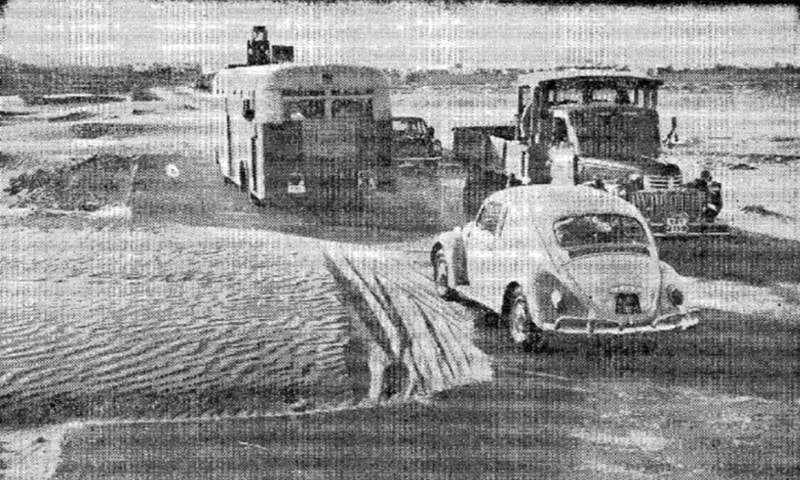
All of this suggests that the increase in population in Karachi was causing every government department to do more than their bit. Still, there were enough empty spaces in the city for things other than humans to fill the land with. On Sept 24, pictures published in this newspaper revealed that a day earlier windblown sand dunes covered as much as half the width of Korangi Road, causing a major traffic hazard. The sand dunes, which disturbed the 18-foot-wide road on barren stretches near the Malir River, created an additional strain for the motorists. The vehicles were forced to crawl along the stretches and at times trucks, cars and buses had to wait for a long time for the traffic coming from the opposite direction to pass. The problem worsened when sand particles shot about in the air obstructing visibility.
Published in Dawn, September 24th, 2018