0
0

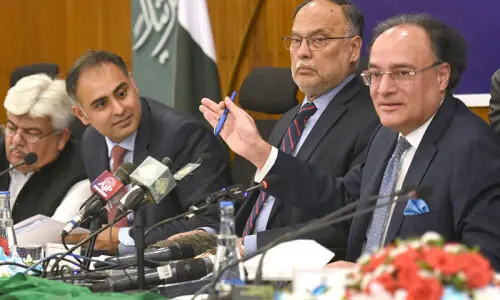
ISLAMABAD, June 12: Experts from both India and Pakistan as well as Kashmir on Saturday called for inclusion of Kashmiris in the current peace process for a settlement of the Kashmir problem. Taking part in the final day’s sessions of a two-day conference on “The Kashmir Dispute in the context of Pakistan-India Dialogue”, organized by the Institute of Strategic Studies, Islamabad (ISSI), they dilated on the role of freedom struggle in the Kashmir dispute, the Indus Waters Treaty and future prospects after the Musharraf-Manmohan meeting.
Dr Hameeda Nyeem of the Kashmir University challenged the very notion that the freedom struggle had contributed to the making of the Kashmir dispute as if it did not exist before and said the issue preceded the freedom struggle.
She also questioned the word “dispute” being used frequently about Kashmir because, according to her, it connoted a problem reduced to a bilateral territorial dispute between India and Pakistan.
She said the freedom struggle had internationalized the Kashmir issue and brought about “paradigmatic cataclysmic changes” in the world’s consciousness, perception and understanding of the issue.
She said, some possible options thrown up by President Pervez Musharraf to break the deadlock had boomeranged as these were taken by the other sides as suggestions of a man in haste.
Mr Farooq Rahmani, Convenor of the All Parties Hurriyat Conference (APHC) in Azad Kashmir, said the freedom struggle had a unique pivot-ability, spontaneity and centrality in the national and social life of Kashmiris. He dismissed the notion that Kashmir’s was a territorial dispute, saying it was actually about the right of the Kashmiri people to choose their destiny.
Mr Rehmani dismissed the notions of the status quo, the Line of Control (LoC) or soft borders as being a solution, and said the issue should be settled on a just basis taking into cognizance Kashmiris’ wishes.
Another speaker, Maj-Gen (Retired) Mahmud Ali Durrani, voiced optimism about future of the Pakistan-India peace process and said the evolving international environment like the nuclearization of South Asia and the 9/11 attacks on the United States had been instrumental in pushing the process forward.
In his opinion, the dialogue process could go forward only if leaders of the two countries showed statesmanship.
An Indian jurist and columnist, Mr A.G. Noorani, pondered on possible solutions that could be acceptable to Kashmiris. He also proposed a solution based on giving maximum autonomy to Kashmir that could also effectively end up the talk on LoC.
Mr Ved Bhasin, chairman of the Kashmir Times Group of Publications, said no solution regarding Kashmir could be arrived at unless Kashmiris were involved.
He also spoke of a dialogue among Kashmiris regarding any future settlement of the dispute and described the present CBMs as a means to reach an amicable solution rather than an end.