0
0
HYDERABAD, June 10: The deputy chief of the Education Sector Reform Assistance (ESRA) programme, Islamabad, Dr Suleman Humayoon, has said that the plan is being implemented under the USAID to bring about educational reforms in the country with emphasis on teachers’ training and improvement in the quality of education.
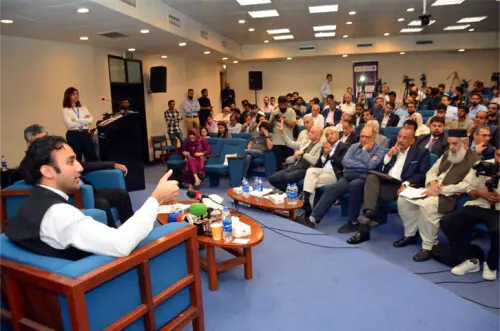
Speaking at a news conference at the University of Sindh on Friday, he said the main focus was on implementation of the programme in Sindh and Balochistan provinces.
He said an amount of $71.5 million had been earmarked for Sindh and Balochistan provinces in furtherance of the objectives.
He said the lion’s share of the funds would go to Sindh where 29,000 teachers, of 34,000, would be provided training.
Dr Humayoon said of 7,000 schools to be covered under ESRA, 5,000 schools had been selected in Sindh.
He said a committee had been constituted which would be headed by Sindh University vice-chancellor Mazharul Haq Siddiqui and Balochistan University vice-chancellor Ghulam Mohammad Taj to recommend ways and means to implement the important programme in an effective manner.
He said Mr Siddiqui would be assisted by educational experts Prof Asif Ali Qazi, dean of the faculty of education, University of Sindh, Abdul Khaliq Chachar and Dr Ismail Saad.
He said Mr Ghulam Muhammad Taj would be assisted by Dr Rasool Bux Essani, Dr Mohammad Hakim and Prof Ghulam Shabbir.
He said the committee would prepare recommendations encompassing all aspects of education including training policy options, remuneration of teachers, fixation of grades, incentives and posting and transfer criteria of teachers.
He pointed out that teaching was a continuous process and with the passage of time changes were needed in the methodology of teaching.
He said it was therefore necessary that the process of teachers’ training should be sustained.
He said the ESRA programme was aimed at proper planning of education, improvement in the quality of education, professional development of teachers and educational managers such as principals and EDOs, promotion of non-formal education and public-community participation through school management committees.
Dr Humayoon said it had been observed that at some schools there were 40 teachers for only 100 students while at the others, there was no one teacher for 100 students.
“This issue of over supply and under supply must be resolved” he said.
About the public-community participation in the implementation of the ESRA programme, Dr Humayoon said each selected school was being given a grant of $1,800 for bringing about physical and educational improvement through school management committees and providing facilities to the students.
He said the media cooperation and community participation were the sine qua non for effective implementation of the education sector reforms.
Replying to a question, Dr Humayoon said the ESRA programme was started in Pakistan in September 2002 and it would end in 2006.
He expressed the hope that it would be extended upto 2010.
Sindh University Vice-Chancellor Dr Mazharul Siddiqui and Balochistan University Vice-Chancellor Ghulam Mohammad Taj were also present on the occasion.