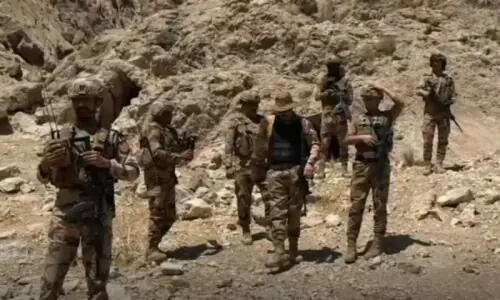
A SPATE of terror attacks in the Diamer district of Gilgit-Baltistan is worrying and mystifying. A sudden eruption of violence over the weekend, with arson attacks on a number of schools in the Diamer region, and helter-skelter attempts by the security apparatus to find the culprits, took another turn on Sunday. Militants on higher ground attacked security personnel and government officials travelling by road below, effectively cutting off two tehsils of Diamer district and narrowly failing in an assassination attempt on a district and sessions judge. The sudden eruption of violence in a region that has been relatively calm in recent times has brought quick explanations from security officials. One is that anti-Pakistan militants in Afghanistan are the architects of the attacks. But security officials in Kohistan, the KP district which shares a boundary with Diamer in GB, have claimed that neither is there an organised presence of militants in Kohistan nor has unusual cross-boundary movement been detected between the latter and Diamer. The second theory, then, is that elements hostile to CPEC and China’s Belt and Road Initiative may be trying to spread unrest in a region that is a choke point for a transformative regional economic programme.
A thorough investigation and transparent sharing of the facts with the public alone can establish the immediate reasons for the upsurge of violence in GB. It is possible that anti-Pakistan militants based in Afghanistan have played a role in organising the attacks, and it is also possible that elements hostile to CPEC and BRI are involved. Inevitably, however, all externally directed attacks require a local infrastructure. If militants based in Afghanistan are responsible for the violence in GB, they can only carry out attacks if facilitated by a network inside Pakistan. Similarly, if external elements trying to destabilise a region critical to the success of CPEC and BRI are involved, they surely cannot conduct attacks without creating local networks. Necessary as it is to expose the so-called foreign hand that is frequently alleged to have its fingerprints all over acts of terrorism inside Pakistan, the long internal fight against militancy and violent extremism will not be won until local networks are identified, found and permanently deactivated. Indeed, the eagerness to point fingers externally often obscures local and domestic failures.
Perhaps most telling is that it was schools, a number of them all-girl institutes, that the militants attacked. There remains a violent extremism embedded in communities across Pakistan that needs to be forthrightly addressed. The incoming provincial and federal governments will have a relatively poor track record of fighting extremism to build on. The National Action Plan exists, but it needs to be reinvigorated and expanded. The price of further inaction could be the Diamer violence replicated in other parts of the country.
Published in Dawn, August 7th, 2018