WHILE there were several flaws in the July 25 polls, modest, yet consequential, achievements were nonetheless made.
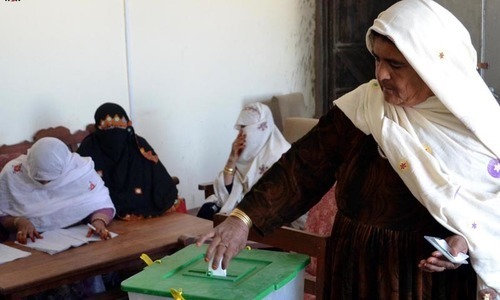
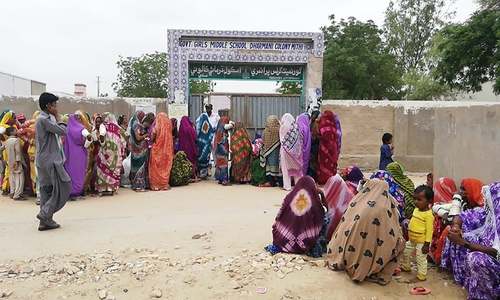
One is that, in Dir, Kohistan and Waziristan, women made clear what they thought of having had their suffrage denied to them for generations by leaving the confines of their homes to vote for the first time.
While women voter registration and turnout levels are still nowhere close to what they ought to be, the ECP’s efforts to shore up these figures, bolstered by mandatory benchmarks established in the Elections Act, 2017, are paying off.
Yet, while the minimum requirement for women’s participation was set at 10pc of total votes in a constituency, there were still areas where female turnout fell short. In NA-10 Shangla, of the 128,302 total votes (including rejected votes, for which there are no gender disaggregated figures in Form 47 to subtract from), 12,663 or 9.87pc were cast by women.
In NA-48 North Waziristan, of the 63,954 votes cast, 6,354 or 9.94pc were women’s. In a report published in this paper yesterday, a source in the ECP stated that a summary had been moved to declare the results of both constituencies null and void for this reason.
Granted, women’s participation in both constituencies undershot the 10pc minimum by a hair’s breadth, yet the ECP is well within its rights to annul the results. Indeed, the bar is set low enough as it is.
However, before by-elections are held, and for their results to be valid, the ECP must establish an inquiry to determine the reasons turnout was low, and investigate allegations made by some candidates (including the winning candidate for NA-48) prior to polling day, that potential women voters were being threatened, and that polling stations were often too far for women to access them.
The ECP must take these claims seriously, including acknowledging its own possible shortcomings, in order to mitigate the likelihood of a similar experience.
Meanwhile, legislators should consider setting the bar higher by introducing an amendment to increase the minimum percentage of women’s turnout in urban constituencies. Institutionalising such provisions can help ensure that there is further progress in the drive to equalise women’s franchise.
Given the pushback witnessed every time there is an attempt to legislate on women’s rights, and efforts that are still made to roll them back, it is not hyperbolic to suggest codifying safeguards against a regression.
Published in Dawn, August 4th, 2018