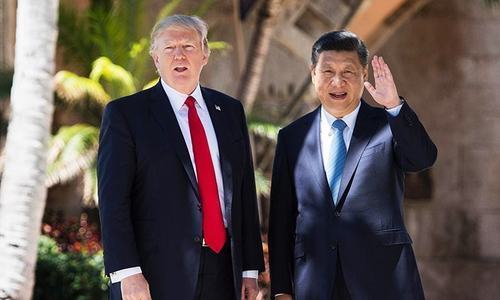
As a trade war looms, one of Chinese President Xi Jinping’s biggest weapons could be boycotts of American brands by his country’s legion of consumers.
But Xi would also be risking collateral damage at home: The China operations of all-American brands ranging from Coca-Cola and McDonald’s to Walt Disney Co are co-owned by state-backed Chinese firms.
One of Coke’s main China partners is government-backed COFCO Corp; Shanghai Disneyland is part owned by a local consortium, and McDonald’s franchisee in the country is controlled by state-backed conglomerate Citic Ltd and private-equity firm Citic Capital Holdings.
“The perfect Stars-and-Stripes corporate victim doesn’t exist,” said Tom Orlik, chief economist in Beijing with Bloomberg Economics. “The number of big clean wins in terms of striking against the other guy - without accidentally punching your own guy in the face - is extremely small.”
Even when Chinese companies don’t have direct ownership links with US brands, Orlik said, boycotts or other non-tariff retaliation would hit the local partners of those American companies.
Early shots in the trade war are set to be fired on Friday, with the US scheduled to impose tariffs on $34 billion of Chinese exports. Beijing has said it will place levies on an equal value of US goods, a move that Trump said would lead to additional penalties. This week, the US moved to block China Mobile Ltd from entering its telecommunications market, citing national security risks.
“By now there is no backing out,” Pauline Loong, managing director at research firm Asia-Analytica in Hong Kong, said on Bloomberg Television on Monday.
Unlike overt actions like tariffs, boycotts by Chinese consumers appear suddenly and usually follow angry rhetoric by government-controlled publications and social media. In earlier conflicts with foreign countries, Chinese citizens inflamed by nationalistic news coverage, boycotted high-profile international brands like Toyota Motor Corp and Hyundai Motor Co, hurting corporate profits and boosting Chinese leverage.
Imports of Chinese goods into the US totalled $505bn in 2017 while China only imported $130bn from the US, limiting Xi’s ability to respond with tit-for-tat penalties. However, American companies sold $280bn of goods and services in China last year through their local subsidiaries, according to Deutsche Bank AG. That creates a big target.
“No US product sold in China, or US company invested in China, can be considered safe from its retaliation,” said Yanmei Xie, a China policy analyst for Gavekal Dragonomics in Beijing.
Besides boycotts, Beijing could consider creating costly administrative bottlenecks for US imports or impose punitive measures against American companies operating in China, analysts at research firm TS Lombard wrote in a June 20 note.
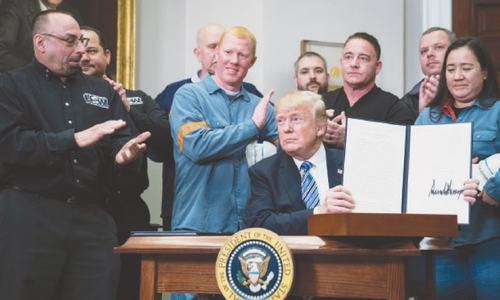
So far government-controlled media have said little on how consumers should respond to a trade war with the US, although an editorial in the Global Times highlighted anti-US sentiment in Europe as well as calls by Canadians to boycott American goods because of Trump’s penalties on imported steel and aluminium. Xi’s government last month said China would retaliate immediately and forcefully to US tariffs.
Bloomberg/Washington Post Service
Published in Dawn, July 4th, 2018