A grave indifference



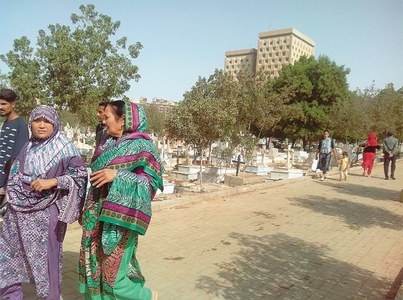
IT IS still early in the morning when Gora Qabristan volunteer Shams Masih surveys the graveyard to look for any uncalled-for damage. He starts near the main gate on Korangi Road to check if the dried bougainvillea branches he had placed there are still intact.
“The thorns in the branches act like barbed wire, keeping the stray dogs out,” he says before heading in the opposite direction to fetch some water from an open tank to sprinkle water on the mud graves.
“These mud graves are very much in danger as stray dogs roam about freely. They come in from where the walls have been broken,” he says.
Gilgit’s British cemetery: a local monument to the Great Game
The largest area where there is no graveyard wall left is on the Sharae Faisal side where, near the pedestrian bridge and green belt, the wall was knocked down in the name of doing away with the advertisement walls. A little ahead there is a boundary wall of the Naval Officers Residential Estate II, or NORE II. It too is covered with advertisement walls, which now have no advertisements.
“They could have just taken down the advertisements from the graveyard wall instead of demolishing it. It has badly exposed the graveyard to all kinds of dangers,” Shams sighs, shaking his head while looking in that direction.
He was talking about the Supreme Court orders to demolish the advertisement walls built all over the city after the earlier order of removing all billboards.
On the opposite side of the broken wall there is a new wall that has come up inside the graveyard near the CSD side. And right across the main entrance on the Bizerta Lines area there is more encroachment.
Covering an area of 20 acres, the Gora Qabristan, or Christian Cemetery, is over 200 years old and has plenty of history buried there. Gora Qabristan, which literally means the graveyard of the ‘fair-skinned’, or ‘white’, doesn’t just have graves from the British Raj when burials took place here between the 1800s and 1935. It also has 58 graves of Polish citizens who happened to be among the 30,000 Polish refugees who came to Karachi after the German invasion during World War II. The Polish burials took place between 1942 and 1955.
The old graves, many of which have been lined and covered with rock, also have some antique art which has been pillaged in recent times. The sculptures of angels have lost their heads or wings and the crucifixes have been broken. Sewage has also washed away some of the old graves.
Shams says that the damage caused to the graves is the fault of the Christian community itself. “They come here to pay respects to their departed family members, they show their concern about the broken walls, the damage to graves and then they go home and forget all about it,” he says.
“Most of the people working in this graveyard are Muslims and it may be my own opinion, but I have seen an indifferent, uncaring attitude on their part toward minorities,” he says.
“We see some 60 to 70 burials taking place in this graveyard every month. The gravediggers are Muslim, the artisans who cement the graves or do marble work are Muslim, as are most of the water carriers and flower sellers.
“Why isn’t the Christian community coming forward to look after their graveyard?” he wonders before shrugging his shoulders and turning away.
Meanwhile, Anwer Sardar Khan, graveyard in charge since 2008, says that he was baffled to find workers from the Faisal Cantonment knocking down the graveyard wall after the Supreme Court order.
“It is sad. The dead of course can’t do anything, but there should be some respect for them. It is only after I made some noise about the matter that I now hear they will rebuild the wall,” he says.
When I put a question to him about the observation made by Shams Masih that the Muslim gravediggers have an indifferent attitude, the in charge says: “Yes, it is true. When I first came here I used to see them as a gift to this place because I thought they truly cared despite being from a different faith. But I now feel that they don’t just come here to earn their roti [bread], but they also want our boti [flesh],” he adds.
“The material they bring for the construction of graves, such as cement, stone and marble, is also of the poorest quality. But if I throw them out now or tell them to go away, I will face an agitation. Such are the problems of the minority community here,” he concludes.
Published in Dawn, July 3rd, 2018