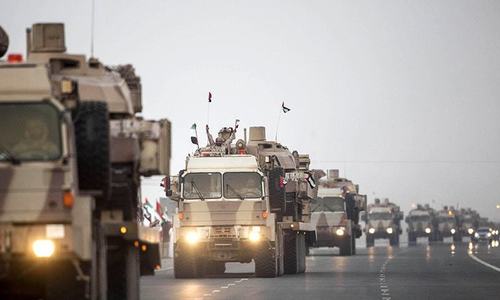
ABU DHABI: The United Arab Emirates on Sunday announced it had halted the offensive it was backing against Houthi rebels in Yemen’s port city of Hodeida to give a chance to UN diplomatic efforts.
In a series of tweets, UAE Foreign Minister Anwar Gargash said the pause was aimed at pursuing negotiations for an unconditional rebel withdrawal from the port but warned that full military action could resume.
The weeks-long offensive on Hodeida — Yemen’s main port — has raised fears of further suffering and deprivation in a country already deeply shaken by years of war between the Iran-backed Houthis and President Abedrabbo Mansour Hadi’s Gulf-backed government.
Pointing to a renewed push for a negotiated settlement by UN envoy Martin Griffiths, Mr Gargash said: “We have paused our campaign to allow enough time for this option to be fully explored. We hope he will succeed.”
He said the pause had been in effect since June 23 and while there was continued “pressure on the parameter”, pro-government forces were awaiting the results of an upcoming visit by Mr Griffiths to the rebel-held capital Sanaa.
Mr Griffiths met Mr Hadi in the southern city of Aden on Wednesday and is reported to be pushing for the Houthis to cede control of Hodeida to the United Nations.
In a speech published by the state-run Saba news agency, Hadi on Sunday hailed the military for its “great victories” in the face of “the most dangerous project of Iranian expansion” Yemen faced.
The rebels, Shia tribes with ties to Iran, have said they may be willing to share control of Hodeida’s port with the UN but say their forces must remain in the docks and the rest of the Red Sea city.
The Houthis have controlled Hodeida and its port since 2014, when they also drove the Hadi government out of the capital and seized large swathes of northern Yemen. On June 13, the UAE and its allies, including Saudi Arabia, launched a massive military operation — dubbed “Golden Victory” — to drive the rebels out of the port.
Pro-government forces managed to seize control of Hodeida’s airport in mid-June after days of heavy fighting but did not immediately push forward into the city, home to some 600,000 people and about 150 kilometres west of Sanaa.
The fighting has claimed 429 lives, according to military and medical sources.
There are no confirmations of civilian casualties, although the UN has documented thousands of residents fleeing combat zones.
Mr Gargash said the operation had succeeded in “forcing the Houthis to make concessions”, but it remained to be seen “whether the Houthis are engaging seriously with this process or using it as a tactic to buy time”.
“Failing these patient efforts we believe that continued military pressure will ultimately bring the liberation of Hodeida and force the Houthis to engage seriously in negotiations.”
Analysts have ruled out major concessions by the rebels in Hodeida without talks on the rest of Yemen’s territory. “The Houthis will not make concessions unless they are guaranteed the upper hand in central and northern Yemen,” said Yemeni analyst Najib Ghallab.
The regional pro-government alliance on Sunday accused the Houthis of “holding hostage” ships docked in the Hodeida port.
Riyadh and its allies earlier imposed a major blockade on the port after a series of rebel missiles were fired from Yemen into Saudi Arabia.
The coalition accuses Iran of smuggling weapons to the Houthis through Hodeida port, a charge Tehran denies.
Oman talks
Mr Griffiths was in the Gulf sultanate of Oman on Thursday, where he met top rebel negotiator Mohammed Abdulsalam, UN radio reported.
Mr Griffiths spoke of progress on the radio and said a proposal to grant the UN a major role in managing the Hodeida port was being studied.
Both the UAE and the Hadi government have held firm to their refusal of anything short of a full withdrawal of the Houthi rebels from Hodeida.
The UN has not publicly commented on Mr Griffiths’ talks on the Hodeida conflict.
A source close to the Yemeni president said Mr Griffiths was expected to return to Aden, where the Hadi government is temporarily based, for another round of talks.
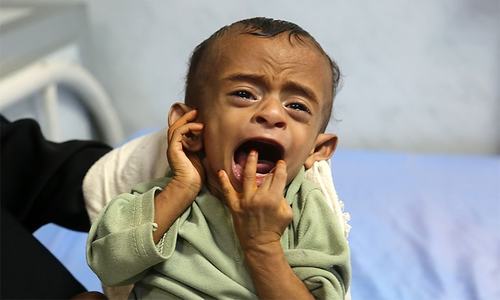
Some 70 per cent of imports to Yemen, where eight million people face imminent famine, flow through the port of Hodeida.
Nearly 10,000 people have died in the Yemen war since 2015, when Saudi Arabia and its allies joined the government’s fight against the Houthis.
The United Nations has called Yemen the world’s largest humanitarian crisis.
Published in Dawn, July 2nd, 2018