3
3

THERE have been numerous successes in the long fight against militancy and the country is undeniably more stable and secure than it was just a few years ago. But two events in recent days have indicated that past and present achievements will not automatically guarantee continuing and future success in the long war.
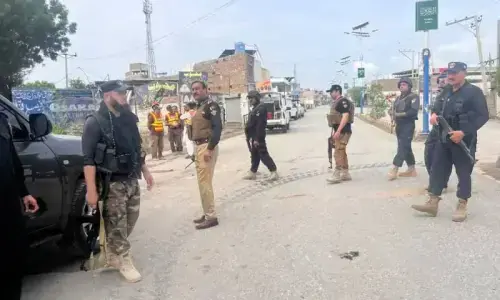
The killing of several militants in South Waziristan, who according to security officials allegedly returned to Pakistan from Afghanistan along with other recently returning refugees, has underlined the difficult of fully securing a region where a major military operation was carried out nearly a decade ago.
Meanwhile, the banned TTP in exile quickly identifying and seemingly arriving at a consensus for a new leader, Noor Wali Mehsud, has underlined that the mere elimination of a senior militant leader will not necessarily lead to an unravelling of the group.
Indeed, the Pakistani security and intelligence apparatus will need to be on the highest alert in the days and weeks ahead. New militant leaderships often need to demonstrate a willingness and ability to launch terrorist attacks and the case of the current TTP head may be no different.
The upcoming general election and what is expected to be frenetic campaigning in the final weeks ahead of the election will surely be the target of militants.
The challenge for the state to hold elections in a climate relatively free from the threat of militant violence will be immense. But the accumulated experience of a decade of regularly scheduled elections, counter-insurgency campaigns and counterterrorism operations ought to help the state in providing stability and security.
It is hoped that the ECP and the caretaker governments will work closely and effectively with political parties to coordinate election-related activities. Mutual cooperation is in everyone’s interest.
The path to addressing the longer-term threat that the TTP presents is clear. Reciprocal steps between Pakistan and the Afghan government, supported by the US in particular, for regional peace and stability are needed.
The US has helped Pakistan by eliminating several successive Pakistani militant chiefs in drone strikes, but it has been inconsistent in its policies in the region and has put too much of an onus on this country to ‘do more’ at all times.
A short-lived Afghan Taliban ceasefire at the end of Ramazan, however, illuminated the possibilities of peace in Afghanistan. The memorable images of Afghan government officials and security personnel embracing members of the Afghan Taliban demonstrated, albeit briefly, that a better future for Afghanistan is within grasp.
Pakistan and Afghanistan must continue to search together for an end to the wars that have so decimated this region.
Published in Dawn, June 25th, 2018