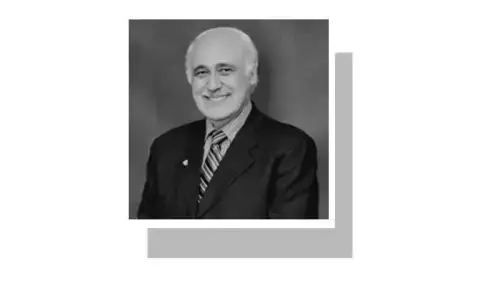
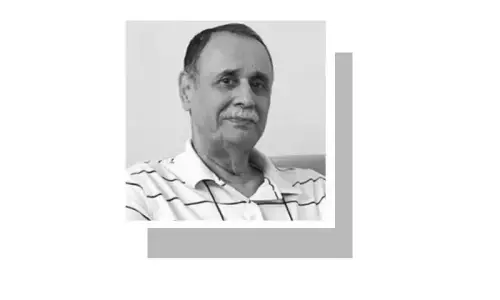
KARACHI: Distinguished translator, short story writer, critic, researcher and University of Wisconsin’s Professor Emeritus of Asian Languages and Cultures Department Mohammad Umar Memon passed away on June 3 in Madison, Wisconsin, the US. He was 79.
Prof Memon had translated a vast body of works from Urdu into English and vice versa, as well as from Arabic into English. The translations included short stories, novels and articles on Islamic Sufism and Muslim philosophy. He was a scholar of Arabic and Islamic Studies first and foremost, but had developed a penchant earlier in his career for various creative expressions, including Urdu, English and Persian literatures. Most important influence on him was that of his eminent father Prof Abdul Aziz Memon, one of the most renowned scholars of Arabic of his times in the Indo-Pak subcontinent with a huge following in the Arabic world.
He was born in Aligarh in 1939, where his father was a faculty member at the Arabic department of Aligarh Muslim University. The teenage Memon along with his family migrated to Pakistan in 1954 and later earned graduate and postgraduate degrees from the University of Karachi. A decade later, he went to the US on a scholarship, getting a degree from Harvard University and later a doctoral degree in Islamic Studies from the University of California, Los Angeles. He had been associated with the University of Wisconsin-Madison for the past 38 years and taught Arabic, Persian, Urdu and Islamic Studies.
In addition to scholars and poets of Arabic and Persian such as Ibne Arabi and Rumi, Prof Memon was a great admirer of Ghalib and Mir.
As for Urdu fiction, he was initially under great spell of Intizar Hussain but later his favourite was Nayyar Masood. He had translated some of his favourite short stories — by Nayyar Masood, Manto, Intizar Hussain, Qurrat-ul-Ain Hyder, Abdullah Hussain, Khalida Hussain, Asad Mohammad Khan, Mohammad Saleem-ur-Rahman and some others — into English. Many of his translations were a product of necessity as well as labour of love, as he felt while teaching Urdu in the US that the English translations of Urdu’s literary works were either lacking in several ways or altogether non-existent.
One of Prof Memon’s many contributions came in the shape of Annual of Urdu Studies — a bilingual research journal — that he launched, edited and published from Madison, the US, despite unfavourable circumstances. Some of his books are ‘The greatest Urdu stories ever told’, ‘An epic unwritten’, ‘The colour of nothingness’, ‘Domains of fear and desire’, ‘Ibne Taimiya’s struggle against popular religion’. Himself a fiction writer, Prof Memon had published a collection of Urdu short stories ‘Tareek Gali’ in the late 1980s.
Published in Dawn, June 6th, 2018