12
12
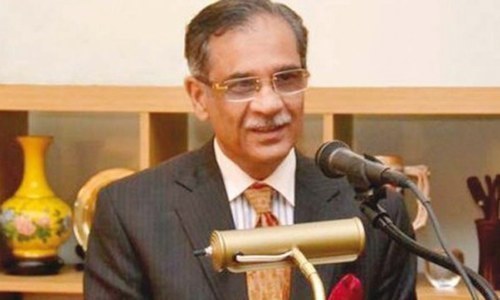
LAHORE: Showing his dismay over faults in the Evidence Act and investigation system in the country, Chief Justice of Pakistan Saqib Nisar on Saturday vowed to stop depending on legislature for improvement (in them) and to seek help of experts in eliminating the modern technology based white collar crime.
Speaking at a workshop on white collar crime investigation here at the Lahore Garrison University, he said he had decided not to depend on the legislature and not to wait for improvement in the laws. “I need to improve the justice delivery system. We need the help of experts to eradicate (white collar) crime. It is equally important for the judiciary to update on technology (involved in exposing and punishing the complicated white collar crime) and on methods of quick justice,” he said.
The chief justice also inaugurated the country’s first-ever International Institute of White Collar Crime Investigation at the same university. It offers training in digital forensics, anti-money laundering, anti-corruption, financial fraud and services in corporate fraud investigation, vulnerability analysis and system breach testing.
The chief justice said he should not be feeling shy of coming to the university for acquiring the technological know-how. The judicial academy should also approach it for the purpose and to know how to punish the modern crime while remaining under the existing legal framework, he said. “We have to do something or we will not be able to deliver anything good to the future generations,” he said.
Shows dismay at faults in Evidence Act and investigation set-up
Earlier, he said the country’s Evidence Act was made in 1972. It was amended in 1984 but the amendments added to the confusions. This law was very important for convictions but it did not have any adequate provision against white collar crime which was an extraordinary vice of the present era. “I saw system and technology in China during a recent visit quite different (improved) from the ones which I had witnessed a year ago there,” he said.
The CJP confessed that the judiciary was not computer literate. Judges were using computers as mere type writers. The smart course of law was also missing, he said, explaining that it was used internationally for quick justice. The judiciary would have to adopt it to clear its huge backlog.
` He said people would ask him about (delays in) his fundamental rights campaign. “I am embarrassed because my house is not in order,” he said.
He said to clear the piles of pending cases, there should either be an alternate dispute resolution system or “we must educate our judges on new techniques and technologies helpful in dispensation of justice.
The chief justice also pointed out unlimited time lawyers avail in prosecuting or defending the accused and writing unnecessarily long petitions. The American Supreme Court gives just half an hour to a lawyer, he said. Faulty investigations too were leading to exoneration of the accused in Pakistan. “They are not experts. I am categorically giving a serious statement. How can we convict criminals with such investigators and such an obsolete law (the Evidence Act), he asked.
Lahore High Court Chief Justice Muhammad Yawar Ali said the country should prepare for eliminating modern day white collar crime like tax evasion, insider trading and money laundering which were the off-shoots of e-commerce, e-banking and international trade. Even credit cards could be misused.
He said modern crime fighting techniques and related technology were needed to overcome difficulties in prosecuting white collar crime as it involved technicalities. But there was also a need to ensure that no innocent was convicted.
Acting Lahore Corps Commander Maj Gen Muhammad Amir presented the vote of thanks. Former Governor retired Lt Gen Khalid Maqbool, LGU Vice Chancellor retired Maj Gen Obaid bin Zakria, lawyer Zafar Iqbal Kalanauri and Supreme Court Bar Association President Kaleem Khursheed also spoke on the occasion.
Published in Dawn, June 3rd, 2018