I SENT a text message to Sabika Sheikh’s host father, Jason Cogburn, never expecting him to respond. He didn’t.
I then called him, he did not pick up, and for a moment I panicked. What would I say if I had to leave a message? It’s not an easy message to leave. However, his voicemail was full and I was spared.
And then a few days later I heard from him.
“I’m okay, we’re okay,” he said.
What was Sabika like, I asked.
“She was just awesome. She laughed, she had a great sense of humour, she was so loving, so smart, incredibly smart. We had her helping us down at the store and just the way she was with the customers, answering the phone and doing what we do and being a part of our family, she just got in so wonderfully well with everyone.”
Take a look: An American's letter to Sabika Sheikh
Standing at Sabika’s funeral, Mr Cogburn said, “I had no idea what God was going to send us. He sent us one of the most precious gifts I’ve ever had in my life. We loved her, and she loved us.”
He shared that when Ramazan started this year, Sabika began fasting, as did his own family. “Because we did things together. Because, really, the root of our issue is love,” he said.
I wanted to speak to Jaelyn Cogburn, Sabika’s host sister schoolmate, and best friend, and I learnt that before Sabika’s arrival in the United States, as part of a State Department-funded scholarship programme, Jaelyn was home-schooled and shy about attending a regular high school. It was Sabika’s vivacious, happy, warm, friendly and inclusive personality that gave Jaelyn the confidence to enrol in the school with her, and they became the best friends, inseparable.
“She was the most beautiful loving person. She was so loyal to her faith and her country,” Jaelyn said tearfully. “She loved her family and she couldn’t wait to see them. And she loved us. She was the most amazing person I’ve ever met, and I will always miss her. Always. Just recently we were going to visit a friend. On our way there I started crying because I knew Sabika was leaving for Pakistan soon. She leaned over to me and whispered in my ear, ‘I love you and miss you too’, though I don’t know why she missed me, I was right there.”
Sabika’s host mother, stood at the podium, draped in a hand-woven shawl that Sabika had given to her on mother’s day, less than a week ago. She talked about Sabika’s love for family and country, and how her room was decorated in Pakistan-inspired memorabilia.
Sabika had spoken to her about why she had wanted to be a part of the exchange programme, “to bring our countries together, to understand the American culture, and for Americans to understand the Pakistani culture...We loved her, and she loved us”.
She had no family in the US, and it was the responsibility of the Pakistani consulate in Houston to transfer the remains of the slain child to her family in Karachi.
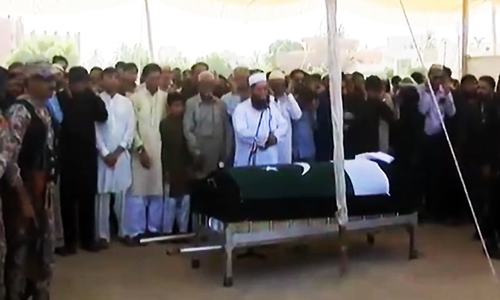
Her funeral was held in Houston and was largely attended by the expatriate Pakistani community and local Americans wanting to pay their respects to the young exchange student.
At the funeral, Taimoor Alam, a 16-year-old Pakistani-American student, who was attending the funeral with his 12-year-old brother Saqib and 16-year-old best friend Devon Platt, said: “I did not know Sabika. I go to a different school, but we told our parents that we wanted to attend the service because we wanted to be a part of celebrating Sabika’s life.”
He added that he wanted to show respect to her and her family. “She was our guest, I’m deeply saddened by her loss. I’m of Pakistani descent, and I often hear people maligning Pakistan,” he said, and commented on the irony of how, when he wanted to visit Pakistan, his friends in the US would say to him in jest, and sometimes seriously, “come back alive”.
He said: “I can’t believe that it’s the opposite. A Pakistani girl came here, to so-called safe America, and died in a senseless random act of school gun violence.”
I asked Devon if he wanted to add something. “All I can say is, I’m sorry Mr Sheikh. I’m heartbroken that you have to suffer the wrath of our guns. I heard that Sabika wanted to be a diplomat, I heard today that she was happy and generous and loving and inclusive. I learnt that Sabika thought Americans did not understand her culture as they should. I promise to understand your culture and other cultures better. I’ll make sure her diplomatic efforts don’t go waste.”
Twelve-year-old Saqib did not want to talk to me. He just looked at a phone screen with big tears streaming down his cheeks, shook his head and looked away.
Published in Dawn, May 29th, 2018