ANKARA: For all of Iran’s fierce verbal response to fresh US threats of tougher sanctions, some senior officials in Tehran believe the door to diplomacy should stay open.
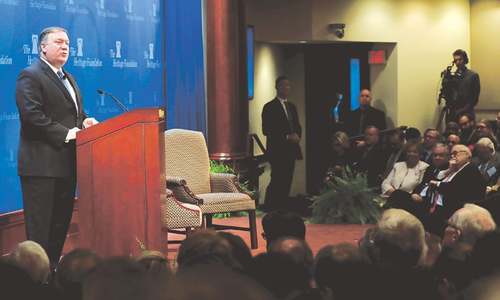
On Monday, US Secretary of State Mike Pompeo presented a list of sweeping demands for Iran, including abandoning nuclear enrichment, its ballistic missile programme and its role in Syria, Lebanon and Yemen, or face “the strongest sanctions in history”.
Four senior Iranian officials contacted by Reuters interpreted Pompeo’s remarks as a “bargaining strategy”, similar to Washington’s approach to North Korea.
Last year US officials were pressing for tougher sanctions against Pyongyang and sent an aircraft carrier to the region in a show of strength before relations eased to a point where President Donald Trump may hold talks with North Korean leader Kim Jong-un.
“America does not want to get involved in another war in the region. Iran also cannot afford more economic hardship ... always there is a way to reach a compromise,” said one of the Iranian officials, who was involved in Iran’s nuclear talks with major powers for two years.
“The era of military confrontations is over,” the official said.
However, it will be difficult for Iran’s Supreme Leader Ayatollah Ali Khamenei to back any diplomatic solution, because doing so could undermine his credibility among his hard-line power base, who reject any detente with the West.
“They [Americans] are lying. Even if Iran accepts all these demands, they will continue to demand more. Their aim is changing Iran’s regime,” said one official who is close to Khamenei’s camp.
“Americans can never be trusted. We don’t give a damn to their threats and sanctions,” he said, echoing Khamenei’s public statements.
Pompeo’s speech did not explicitly call for a change in leadership in Iran, but he urged the Iranian people to reject their clerical rulers.
‘Cup of poison’
Earlier this month the United States withdrew from a 2015 multinational deal which restricted Iran’s nuclear programme in return for lifting sanctions that had crippled the economy.
Tehran says its right to nuclear capabilities and its defensive missile programme are non-negotiable.
But with Iran’s economy so fragile, weakened by decades of sanctions, corruption and mismanagement, Khamenei may yet consider diplomacy over confrontation with the United States.
Some insiders said that, though difficult, he could drink “the cup of poison”, as his predecessor Ayatollah Ruhollah Khomeini described it when he reluctantly agreed to a UN-mediated truce that ended the 1980-88 Iran-Iraq war.
“For most Iranians, the economy is the main issue, not what Iran does in the region or the country’s nuclear programme,” said a senior Western diplomat in Tehran. “That is why Iranian leaders will show some flexibility despite the harsh rhetoric.”
Trouble at home
It was Iran’s weak economy that forced Khamenei to give tentative backing for the 2015 nuclear agreement with major powers. The deal, engineered by pragmatist President Hassan Rouhani, ended the country’s economic and political isolation.
The establishment’s core support comes from lower-income Iranians, who joined anti-government protests in January. The unrest was a reminder to authorities that they were vulnerable to popular anger fuelled by economic hardship.
“If they fail to manage the economy, then the regime will not be able to resist the pressure. It does not mean it will fall apart, but the economy could reach its worst ever breaking point,” said Meir Javedanfar, an Iranian-born expert on Iran at the Interdisciplinary Center Herzliya in Israel.
European parties to the nuclear deal are trying to rescue it after Washington’s exit by keeping Iranian oil trade and investment flowing. But they concede it will be difficult.
A third Iranian official said he expected that the United States would eventually have to accept some level of Iranian uranium enrichment activity and ballistic missile work, because “these are Iran’s red lines”.
In his speech, Pompeo tried to quash talk of war by saying Washington would lift punishing sanctions it is now moving to impose, restore diplomatic and commercial ties and allow Iran to have access to advanced technology if Washington saw tangible shifts in Iran’s policies.
‘Declaration of war’
Several Iranian officials told Reuters that the hard-line elite, including Iran’s Revolutionary Guard Corps (IRGC), viewed Pompeo’s demands as a “declaration of war” against Iran.
Analysts said the risk of a broader conflict could not be ruled out, despite running counter to Trump’s own stated desire to disentangle the United States from a generation of costly conflicts in the Middle East.
“If Americans push Iran to the corner ... then Iran will have no other option but to react harshly,” said Tehran-based analyst Saeed Leylaz. “This is what hawks want.”
While Tehran has said it would respond to any military aggression by targeting US interests in the region and Israel, some experts said the country would struggle to defend itself against a direct, multi-fronted attack.
“Iran has done well in proxy wars, but they cannot confront Israel or the US in a direct war,” said the Western diplomat. “They don’t have modern weapons.”
Shia Muslim Iran backs President Bashar al-Assad in Syria’s civil war, Shia militias in Iraq, Houthi rebels in Yemen’s conflict and Lebanon’s Hezbollah movement.
Washington’s regional allies, Sunni Gulf Arab states and Israel — staunch foes of Tehran — have all praised the United States’ toughening stance on Iran.—Reuters
Published in Dawn, May 24th, 2018