42
42

WASHINGTON: The World Bank said on Tuesday that it was holding talks with a Pakistani delegation to seek an amicable resolution of its water dispute with India.
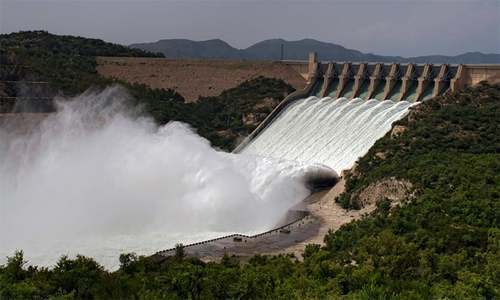
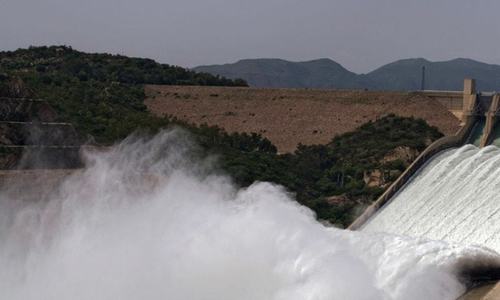
A Pakistani delegation, headed by Attorney General Ashtar Ausaf Ali, arrived in Washington on Sunday, a day after Indian Prime Minister Narendra Modi inaugurated a controversial dam in India-held Kashmir, which Pakistan fears will reduce its share in the waters of the Indus and its tributaries.
The Indus system of rivers comprises three western rivers — the Indus, Jhelum and Chenab — and three eastern rivers — the Sutlej, Beas and Ravi. The controversial Kishanganga dam is built on the Neelum river, which is a tributary of the Jhelum river.
“Senior World Bank officials are meeting on Monday and Tuesday with a Pakistan delegation at their request to discuss issues concerning the Indus Waters Treaty,” a World Bank spokesperson, Elena Karaban, told Dawn.
The 1960 Indus Waters Treaty gives Pakistan exclusive use of the western rivers, the Jhelum, Chenab and Indus, while the eastern rivers — Ravi, Beas and Sutlej — go to India.
“The meetings are discussing concerns raised by the Pakistan delegation and opportunities within the treaty to seek an amicable resolution,” Ms Karaban said.
The World Bank supervised the talks that led to the treaty, which gives it a key role in settling water disputes between India and Pakistan. But in a recently updated factsheet, the bank says that its role in relation to “differences” and “disputes” is limited to the designation of people to fulfil certain roles when requested by either or both of the parties. The bank, however, considers the treaty a major achievement, which has successfully prevented water wars between South Asia’s two nuclear-armed nations.
“The Indus Waters Treaty is a profoundly important international agreement that provides an essential cooperative framework for India and Pakistan to address current and future challenges of effective water management to meet human needs and achieve development goals,” said Ms Karaban while explaining why the bank considered the treaty one of its major achievements.
Both Pakistan and India have stayed engaged with the World Bank over the last 70 years, seeking its assistance whenever they had a dispute over the interpretation of the treaty.
In August 2016, Pakistan asked the World Bank to appoint a court of arbitration to review the designs of Kishanganga and another project on the Chenab, called Ratle. India rejected the suggestion, saying that Pakistan’s objections were technical in nature and that the matter should be decided by a neutral expert.
Pakistan disagreed, arguing that a decision by a technical expert was non-binding and India would be under no obligation to implement the expert’s recommendation.
In December 2016, World Bank President Jim Yong Kim paused the process of negotiation to help India and Pakistan consider alternative approaches to resolve their dispute over the two hydroelectric plants. “We are announcing this pause to protect the Indus Waters Treaty,” he said.
The World Bank said that this week’s meetings were also being held on Pakistan’s request.
While explaining why it was important to protect the treaty, the World Bank said it had “survived frequent tensions, including conflict, and has provided a framework for irrigation and hydropower development for more than half a century”.
The bank’s factsheet also referred to a statement by former US president Dwight Eisenhower, who described the treaty as “one bright spot... in a very depressing world picture”.
Under the treaty, India is permitted to construct hydroelectric power facilities on the rivers concerned, subject to constraints specified in annexures to the treaty.
Published in Dawn, May 23rd, 2018