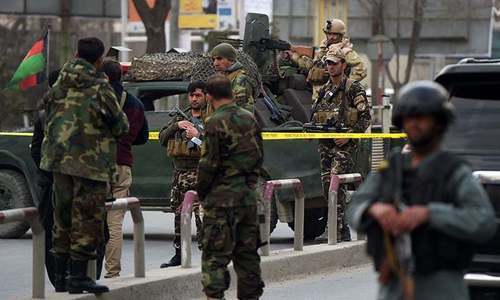
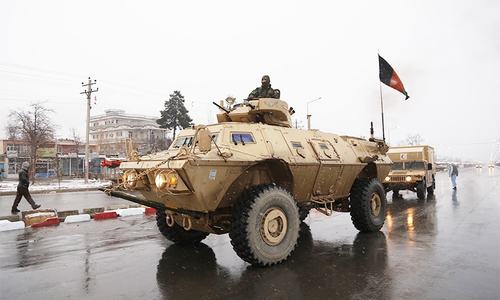
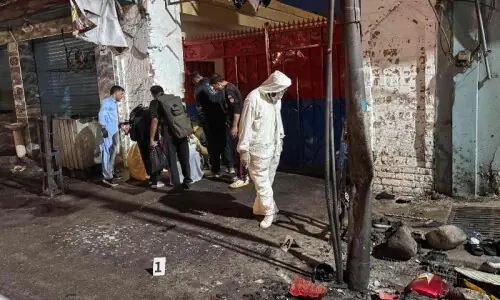
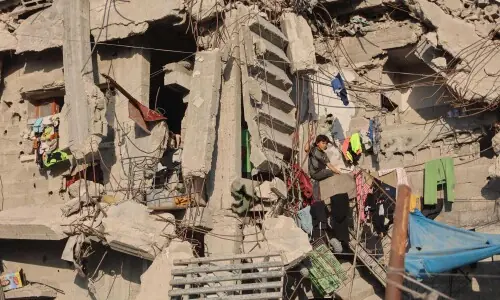
ONCE again, life came to a standstill in parts of Afghanistan after a series of devastating attacks: twin suicide bombings in the capital, followed by another attack in Kandahar, and a shooting in Khost.
The Afghan Taliban’s annual spring offensive may have technically begun only a few days ago, but for ordinary Afghans there had never been any let up — especially not with an emboldened militant Islamic State group escalating the state of terror, as both outfits vie against each other with increasing brutality.
Yesterday’s IS-claimed attack in the heavily fortified heart of the capital dealt a deadly blow to its already beleaguered press corps; nine journalists — another journalist died in a separate incident in Khost — were killed by a second bomber, disguised as one of them, as they rushed to the scene of the first bombing.
The horror of the enemy in plain sight is not an unknown phenomenon to Kabul — in March last year, IS gunmen (some dressed as doctors) stormed a military hospital, while the Taliban claimed the shocking ambulance bombing earlier this year.
Still, the tactic of targeting emergency first responders, volunteers and journalists in a secondary attack is a grisly escalation of the violence which the Afghan government seems helpless to contain.
We grieve for journalists in Afghanistan, who even prior to this dark day were no strangers to such tragedy.
There have been several attacks on TV stations in recent years, and Reporters without Borders documented the death of at least 15 media workers in Afghanistan in 2017.
Reporting itself has become more difficult, as pressure from insurgents has created ‘information black holes’ and prompted many women to leave the profession.
The necessity of unrestricted and extensive reporting (especially of underrepresented voices) cannot be stressed enough.
Yet, being the first to cover a newsworthy event is never worth losing one’s life for.
The Afghan media might note, for example, how here in Pakistan we responded to the issue of secondary targeted attacks by establishing consensus to maintain a safe distance from bomb sites until law enforcement arrives and secures the area.
There is another reason to be circumspect about such coverage; terrorists thrive on media attention, and a strong correlation has been found between sensationalist reporting on terror-related incidents and follow-up attacks.
But a time lag is only a precaution, not a guarantee of safety, as it becomes clearer day by day that for peace and security to return to Afghanistan, Kabul must initiate talks on a political settlement.
Published in Dawn, May 1st, 2018