0
0

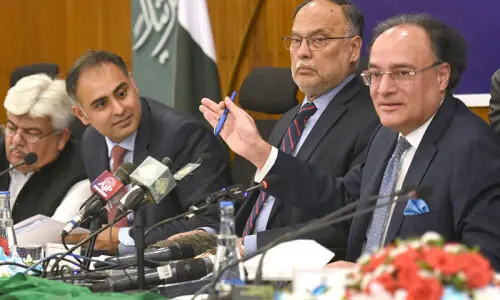
ISLAMABAD, May 20: The government has decided not to seek any direct foreign assistance to fund the next budget which is likely to show a deficit of 3.2 per cent of the GDP. “We plan to contain budget deficit at 3.2 per cent of the GDP and would use $1 billion Sukuk and Eurobonds funds to meet the requirement of foreign financing for the new budget,” Minister of State for Finance Omar Ayub Khan said.
Talking to Dawn, the minister said that the budget would lay stress on the ‘Khushhal Pakistan Programme’ for improving the infrastructure in rural areas. He said five components of the Khushhal Pakistan Programme would get increased funding — provision of electricity and gas, clean drinking water, farm-to-market roads, micro-credit and vocational training.
Responding to a question, Mr Khan, who will present the budget in the National Assembly on June 6, said the government had decided not to approach the IMF, the World Bank or any donor agency to help it meet the foreign component of the budget.
The budget, he said, would be largely met by ensuring substantial revenues and using the Sukuk and Eurobonds funding. He said the CBR would have to play an effective role in generating adequate revenues. “Our tax-to-GDP rate has to increase, like in other developing countries,” the minister said, adding that leakages in tax collection would have to be plugged to generate more revenue.
He regretted that the CBR in the past did not play its role to increase revenues “but now the revenue machinery will have to come up to the expectations for which the World Bank has also given $120 million for the restructuring of the organization”.
In reply to a question, the minister said the budget would also have special fundings for small dams, water security, energy security, ports and shipping and development of roads. Without improving the infrastructure it would be difficult to achieve desired results, particularly those related to alleviating poverty and creating jobs.
“For the first time we have undertaken a complete exercise both at the macro and micro level to spend more on infrastructure development and human development,” Mr Omar Ayub said.
The minister was of the view that maintaining the 8.35 per cent GDP growth rate would be a big challenge for the PML government. This rate had been achieved after well over 20 years as a result of better economic polices and offering a level-playing field to the private sector, he added.