ISLAMABAD: Pakistan and Afghanistan will undertake effective actions against fugitives and the irreconcilable elements posing security threats to either of the two countries, according to an agreement reached between the two sides during Prime Minister Shahid Khaqan Abbasi’s visit to Kabul last week.
During the visit, the two sides agreed on seven key principles to operationalise working groups under the Afghanistan-Pakistan Action Plan for Peace and Solidarity (APAPPS) to remove misunderstandings between the two countries and enhance cooperation in the fight against terrorism.
According to a statement issued by Foreign Office on Sunday, Pakistan will be required “to support the Afghan-led and Afghan-owned peace and reconciliation (efforts),” and “the two countries will undertake effective actions against fugitives and the irreconcilable elements posing security threats to either of the two countries”.
Under the agreement, the statement said, “both the countries (are required) to commit to deny use of their respective territory by any country, network, group or individuals for anti-state activities against either country”.
The two sides will also be required “to put in place a joint supervision, coordination and confirmation mechanism through liaison officers for realisation of the agreed actions,” it said, adding that both the countries had committed to avoid territorial and aerial violations of each other’s territory.
Besides this, the FO said, both Pakistan and Afghanistan had agreed “to avoid public blame game and instead use APAPPS cooperation mechanisms to respond to mutual issues of contention and concerns.”
Similarly, the two countries would “establish working groups and necessary cooperation mechanism as per APAPPS for full implementation of the APAPPS and the above mutually reinforcing principles.”
During the day-long visit of Prime Minister Abbasi to Kabul on April 6, Pakistan and Afghanistan had agreed to finalise their bilateral dialogue framework as Islamabad reaffirmed support for the Afghan government’s offer of peace dialogue to the Taliban and urged the militant group to join the reconciliation process without any delay.
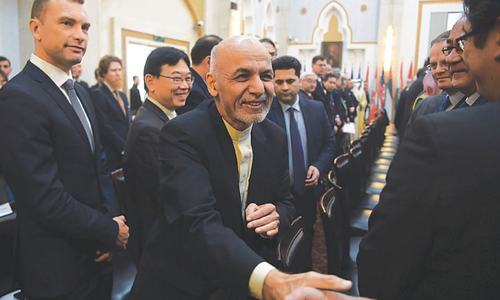
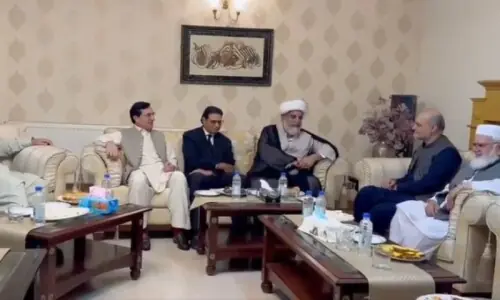
Mr Abbasi held talks with President Ashraf Ghani and met other Afghan leaders, including Chief Executive Abdullah Abdullah and High Peace Council chief Karim Khalili.
The prime minister had undertaken the visit of Kabul on the invitation of President Ghani who had, at the Kabul Process meeting on Feb 28, offered talks to the Taliban and vowed to repair ties with Pakistan.
The discussions were said to be held in “a very cordial and friendly atmosphere”.
It was during PM Abbasi’s meeting with Mr Ghani that the two sides had agreed that APAPPS could be a useful framework for broad-based and structured engagement on all issues of mutual interest.
The APAPPS is a Pakistani initiative for cooperation in the areas of counterterrorism and reduction of violence, peace and reconciliation, refugees’ repatriation and joint economic development. The plan enjoys the support of China and the United States.
Pakistan and Afghanistan had been negotiating the new engagement framework for months and had held at least three rounds of talks at the foreign secretaries’ level. However, the Afghans had been cautious and had complained that the proposed plan did not adequately address their concerns.
The proposed APAPPS will have five groups when it becomes formally operational, including the one on security and intelligence cooperation.
PM Abbasi’s visit was preceded by Afghan allegations that Pakistan Air Force jets had bombed areas in bordering Kunar province of Afghanistan.
The allegation was immediately rebutted by the Foreign Office which said the air raids had hit terrorist targets within the Pakistani territory that enabled cross-border attacks from sanctuaries on the other side of the border.
The prime minister had also met senior political leaders, including Gulbuddin Hekmatyar, Ustad Mohammad Mohaqiq, Ustad Mohammad Karim Khalili and Pir Sayed Hamed Gailani, to convey the support of the government and people of Pakistan to all ethnic groups in Afghanistan and underscore Pakistan’s commitment to peace and stability in Afghanistan.
Published in Dawn, April 9th, 2018