0
0
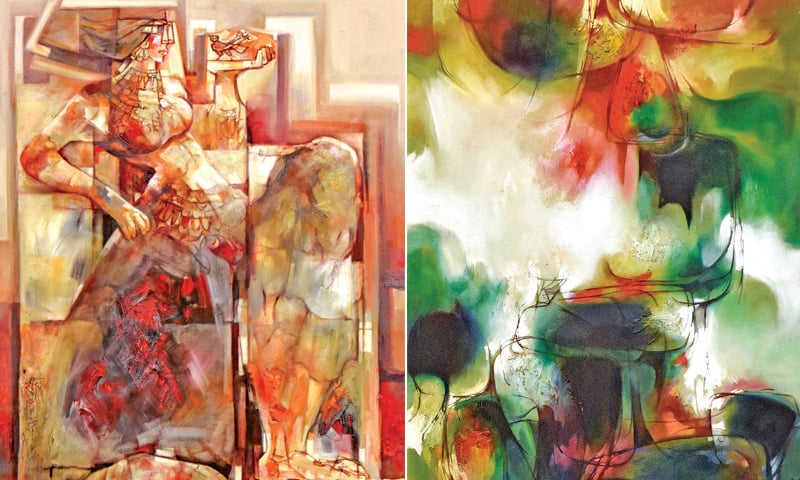

ISLAMABAD: A book launched on Mansoor Rahi on Thursday traces personal and political trials he witnessed, and their impact on his work.
The book, Rahi – the Cubist Legend of Asia, was launched at the Pakistan National Council of the Arts (PNCA).
Written by his son, Danish Rahi, it encompasses the artist’s life, passion and contribution to Pakistani art.
Speaking at the book launch, PNCA Director General Jamal Shah described Rahi as a darvesh, a brave and genuine artist who transcended artistic boundaries, has a deep understanding of Cubism that is based on curiosity, and shared his art with others with generosity.
Dr Arjumand Faisal, a noted artist and curator, shared his 48-year association with Rahi and said that he had been pushing and persuading him to publish a book. It took 10 years to materialise and he hoped that the second volume will be published soon.
Speaking about his work, the excited Mr Rahi said “his son has made him immortal” by documenting his work.
Talking to Dawn about his migration from West Bengal to Dhaka and Pakistan, and the evolution of his work from simple painting to Cubism, Mr Rahi said: “Evolution is life and monotony is the killer of element.”
Danish Rahi, a United States-based digital designer by profession, spoke about the book and said that while starting the project in 2016, he kept in mind three questions to address in the book: who is Mansoor Rahi, how to collect tangible and authentic data, and what is the role of modernist, indigenous Cubist mindset in Asia.
Inspired by the Cubism movement, created by Picasso and Georges Braque in Paris between 1907 and 1914, Mr Rahi’s works show an affinity towards the work of Picasso and Braque as they depict a conceptual view of nature rather than perceptual one.
He has exhibited extensively in Pakistan and abroad, and shot to prominence from his ‘Grey Genesis’ and ‘Wild Horse’ series as well as ‘World Food Crisis’, ‘Soul in Hell’ and ‘Struggle for Achievement’.
Shakir Ali and Mansoor Rahi were the pioneers who introduced modernism to art in the shape of Cubism. Mr Rahi also won the Shakir Ali Award at the first International Biennale Show in 1987. In 2008 he received a Pride of Performance Award.
Born in 1939 in the Malda district of West Bengal, Abul Mansoor Ahmed - better known as Mansoor Rahi, moved with his family to Rajshahi after partition. He later moved to Dhaka and graduated from the Government College of Art and Craft and held his first exhibition in 1957.
Published in Dawn, March 23rd, 2018