THE immediate implications may centre on the political future of one individual, but the judgement has the potential to be hugely disruptive to the democratic process itself.
The highest court in the land should be accorded the highest respect. Without the judiciary, the rule of law is impossible.
But — and it is with profound regret that this caveat has to be stated — the judgements of the Supreme Court of Pakistan need to promote the rule of law and constitutional democracy, not add to the national confusion.
Nawaz Sharif, already ousted from the prime minister’s office last year, has now been ousted from the presidency of the PML-N.
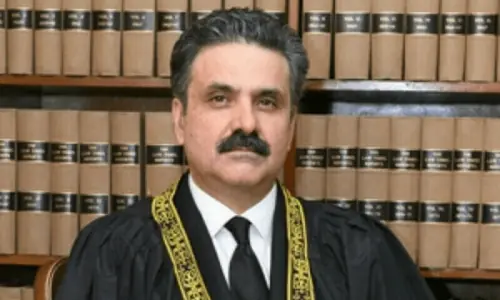
In its short order, a bench of the Supreme Court headed by Chief Justice of Pakistan Saqib Nisar has ruled that because Mr Sharif has been disqualified from parliament and because the office of president of a political party has direct implications for the composition and working of parliament, Mr Sharif is ineligible to be president of the PML-N.
The ruling is extraordinary and seemingly pits a fundamental right, Article 17 of the Constitution, which guarantees freedom of association, against the qualification and disqualification criteria for parliamentarians, also part of the Constitution.
Perhaps the detailed judgement, to be issued at an unspecified later date — not unusual for the superior judiciary, but an unfortunate norm that ought to be discouraged because it can create constitutional and legal uncertainty — will provide reasoning that independent analysts and jurists may find they can support.
Already, however, it is apparent that a profound departure from democratic norms is under way.
A member of parliament has the power to legislate and can be part of the federal government — power and privilege that demand exceptional scrutiny of those who possess them.
A political party has no such power and privilege, and democratic norms ought to encourage, not discourage, all members of society to be part of the political process.
Certainly, no one can be above the law, even if that person is a three-term prime minister and the head of the largest political party in the country.
But a responsibility flows in the opposite direction too: the law and its interpretation by the courts must promote justice, be fair and not person-specific.
Mr Sharif’s barbs aimed at the judiciary since his ouster last July have been unedifying and uncomfortable.
Polluting the electoral reforms package by introducing a person-specific clause to restore Mr Sharif to the position of party president was an unwise and unnecessary act on the PML-N’s part.
The responsibility of the judiciary, however, is to interpret the law, not invent it.
The retrospective effect of the court’s decision, nullifying all decisions taken by Mr Sharif since his re-election as party president, is also deeply troubling.
The judicialisation of politics should be resisted by the judiciary itself.
Published in Dawn, February 23rd, 2018