THE government intends to announce a tax amnesty scheme, offering relief to those who will bring foreign exchange back to the country and announce their properties abroad.
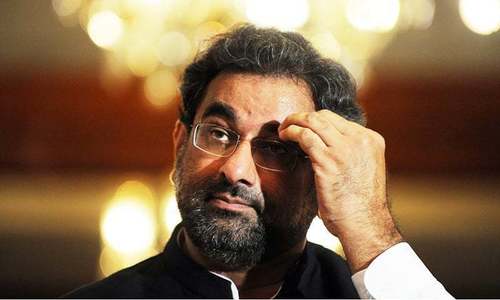
According to media reports, Prime Minister Shahid Khaqan Abbasi is seeking plans to plug leakages, encourage correct property valuation, lower individual tax rates and offer an amnesty programme.
Working on a multi-pronged strategy, the government wants its officials to build taxpayer profiles and keep an eye on spending patterns. The current administration has five months to implement the prime minister’s vision to widen the tax net through profiling and monitoring.
Pakistan has a history of amnesty schemes, starting from the first in 1958 to the one offered only eight months ago. Despite successive amnesty schemes, according to an estimate, the informal economy has doubled in size compared to the formal economy.
The growing dark side of the economy plagues not only Pakistan but many other developing countries. Off-the-books transactions account for one-fourth of the global gross domestic product (GDP).
A meagre tax-to-GDP ratio is a risk to our economy and is damaging the functionality of state. Pakistan’s tax-to-GDP ratio of about 12pc is the lowest regionally and among the lowest globally. Regularising off-the-book assets through amnesty schemes has failed to speed up tax recovery in the past owing to lack of public enthusiasm.
Amnesty schemes do not only discourage documented taxpayers by legalising illegal assets at lower rates of taxes, but they also undermine the state’s capacity to tax in the future. The state’s power to tax its people is derived from its capacity to generate revenue and invest in purposive long-term activities to create an asset base for sustained economic development.
Policymakers need to ensure that such schemes are not politically motivated, but part of a wider tax reform
Fairness in collecting and spending state’s revenue through installing checks and balances is considered a prerequisite of sustained economic development. Tax fairness is based on the idea that tax legislation does not benefit only a segment of the population.
It is profiling and taxing people according to their expenditure patterns that contribute to betterment of the taxation machinery of a country. Amnesty schemes encourage tax evaders by propagating the notion that another such scheme is always on the horizon to legitimise their illicit wealth.
If policymakers have to lower the bar for a noble cause, they need to make sure that it is not a politically motivated slogan for the coming general elections or another slap on the wrist to tax evaders.
To engender tax culture we need to make sure that the amnesty scheme will come as part of wider tax reforms with a mechanism to monitor spending. Without an equitable taxation system and compliance mechanism the fiscal capacity of the state to tax becomes restrained.
A study on how Pakistan’s tax system can be reformed was done by the Sustainable Development Policy Institute in 2013. The draft report shows that the compliance ratio is the lowest among voluntary tax payments. In addition to complications and costs associated with the taxation system, sociological impediments to voluntary taxation are reduced by transparency in spending taxed money.
The purpose of taxes is to raise revenue to run state affairs, to encourage economic growth and to deliver social services to citizens. For purposeful spending of taxed money under political stewardship, a monitoring and planning mechanism should be formed comprising the central bank, the Federal Board of Revenue and the Securities and Exchange Commission of Pakistan.
The prime minister anticipates a GDP growth rate of 6pc during this fiscal year. To achieve this, the government should not only make efforts on collection sides but it should also make spending more transparent.
For sustainable economic development we need to implement tax reforms and broad-base taxes like value-added tax. The VAT system was introduced in 2010 but was shot down by political parties in parliament.
The government can muster support for legislating and implementing this forgotten but much-needed taxation instrument which has contributed greatly to Western revenue systems and development.
Our tax compliance ratio has declined substantially over the last decade. There are around 3.4m registered taxpayers, but only 20pc actually pay taxes. In order to reform the tax system we need to increase voluntary tax filing and implement equitable broad-base taxes.
Published in Dawn, The Business and Finance Weekly, February 19th, 2018