16
16


ISLAMABAD: It is anticipated that Pakistan’s greenhouse emissions will double in two years and surge 14 times by 2050 — much higher than the world average. This will pose serious threats to the country’s population, as well as lower agricultural and energy outputs.
These dire warnings were a part of the Climate Change Profile of Pakistan, prepared by Dr Qamar Uz Zaman Chaudhry, an international climate technology expert and former director general of the Pakistan Meteorological Department. The report has been launched by the Asian Development Bank.
“Pakistan potentially faces a major climate change,” says the report, while warning that the impact of global warming in Pakistan is likely to be above the global average. It adds that climate change will impact the glaciers’ melting rate and precipitation patterns, particularly affecting the timing and strength of monsoon rainfall.
“Consequently, this will significantly impact the productivity and efficiency of water-dependent sectors such as agriculture and energy,” says the report, which also suggests concerted efforts by the government and civil society at all levels to mitigate these threats.
Over the last 50 years, Pakistan’s annual mean temperature has risen by roughly 0.5 degree centigrade. The duration of heat waves per year has increased by nearly fivefold over the last 30 years. The sea level along Karachi coast has risen by about 10 centimetres in the last century.
By the end of this century, the annual average temperature in Pakistan is expected to rise between 3C and 5C in a scenario with central global emissions, while higher global emissions may yield a rise of between 4C and 6C. The average annual rainfall is not expected to have a significant long-term trend, but is expected to exhibit large inter-annual variability. The sea level is expected to rise by a further 60cm by the end of the century and will most likely effect low-lying coastal areas south of Karachi toward Keti Bander and the Indus River delta.
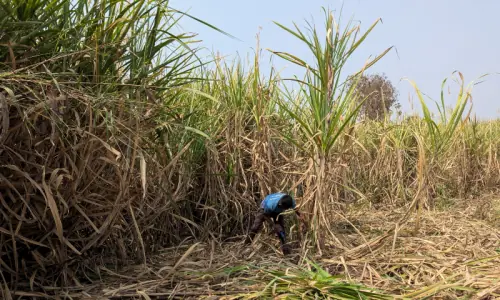
Under future climate change scenarios, Pakistan is expected to experience increased variability of river flows due to increased precipitation and the melting of glaciers, the report says. Demand for irrigation water may rise due to higher evaporation rate. Yields of wheat and basmati rice will decline and could drive production northward, subject to water availability. It says that water availability for hydropower generation may also decline.
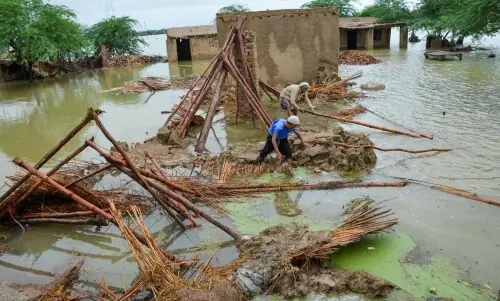
Hotter temperatures are likely to increase energy demand due to increased air conditioning requirements. Warmer air and water temperatures may decrease the efficiency of nuclear and thermal power plant generation. Mortality rates may increase due to extreme heat waves. Urban drainage systems will be further stressed by high rainfall and flash floods, while sea level rise and storm surges may adversely affect coastal infrastructure and livelihoods.
According to the national GHG inventory of Pakistan, for the year 2011-12, total GHG emissions were at 369 million tonnes of carbon dioxide equivalent (MtCO2e) with 45.9pc share of energy, 44.8pc share of agriculture and livestock sectors, 3.9pc share of industrial processes, and 2.6pc share of land use change for forestry sectors. Energy, agriculture and livestock sectors alone account for 90.7pc of the total emissions pool and have thus far remained the biggest emitters of GHGs since 1994.
Over the last century, Pakistan’s average annual temperature has risen by 0.57C, compared to 0.75C for South Asia, and average annual precipitation has increased by 25pc. The warming is mainly due to an increase in winter temperatures. Heat wave days per year have increased by 31 days between 1980 and 2007.
Published in Dawn, February 7th, 2018