SOME sections of the media in Pakistan operate in an ethics-free zone, crossing the line between fact and fiction with few compunctions, no matter how serious the possible consequences. Indeed, they seem to have taken on some of the worst aspects of an often sensationalist social media.
A recent example is the Zainab rape-murder case where some elements have propounded theories with such certitude that these could easily be misconstrued as fact.
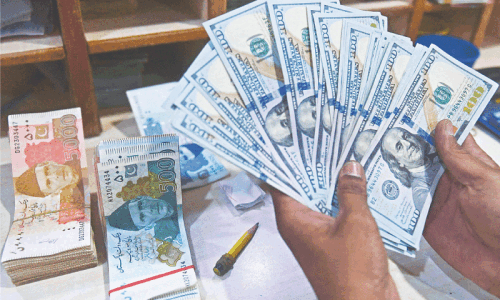
Take the claim of a well-known anchor that the prime suspect in the Zainab rape-murder case was operating several foreign currency accounts and had links with an international child pornography ring. A JIT inquiry probing the claims, with the help of the State Bank, reported that no such accounts exist.
However, the allegations have continued, sowing confusion in the public mind in a matter where emotions are already running high. A new JIT has now been formed to yet again look into his claims.
Notwithstanding the best efforts to fact-check information before putting it in the public domain, misinformation — that is, inadvertent dissemination of incorrect information — is an occupational hazard for journalists, and it should be promptly dealt with through corrections and clarifications.
Read: Fake news in Pakistan
Disinformation, or fake news — an oxymoron in the eyes of journalistic purists — is a far more dangerous beast. Driven by personal motives and a desire for self-aggrandisement, it is often strategically used to further sinister agendas that emanate from segments of society inimical to democratic ideals. Of course, fake news, especially in a world where social media sometimes sets the agenda, is not exclusive to Pakistan.
It is present even in countries where mainstream media is relatively free, official sources of information more accessible and hence the public less susceptible to conspiracy theories. The most effective antidote to fake news everywhere is a media that provides information that is, as far as possible, reliable, accurate and objective. Such an approach would act as a check even on the rumours and calumnies that emerge from social media.
Unfortunately, however, sections of the Pakistani media — especially among the news channels — have come to regard themselves as an unaccountable force, a bully pulpit armed with a licence to manipulate public opinion, even if lives are put at risk.
Journalists in Pakistan have fought a long battle for press freedom. Their struggle against autocratic regimes’ efforts to silence them or act as vehicles for their demagoguery could be lost by a few media persons who appear to have vested interests.
Published in Dawn, January 29th, 2018