0
0

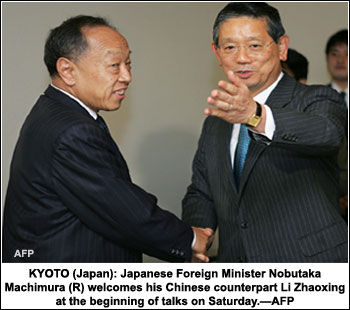 KYOTO (Japan), May 7: Japan and China agreed on Saturday to try to improve strained ties and meet soon to discuss a disputed gas field, but the two Asian giants remain at odds over their wartime past, a Japanese official said. Japanese Foreign Minister Nobutaka Machimura met his Chinese counterpart, Li Zhaoxing, after a meeting of Asian and European foreign ministers in the Japanese city of Kyoto.
The talks followed last month’s summit where Japanese Prime Minister Junichiro Koizumi and Chinese President Hu Jintao pulled ties back from the brink after a rare public apology by Koizumi for suffering caused by Japan’s past military aggression.
“Overall, there was a very frank exchange of opinions. The overall tone is to continue efforts to improve Japan-China relations based on the Jakarta summit and Foreign Minister Machimura’s visit to China,” the Japanese official said of the Machimura, Li talks.
The two sides agreed to hold discussions later in May on a dispute over gas fields in the East China Sea. China and Japan, the world’s second and third biggest oil consumers, have been at odds for months over China’s energy exploration near an area in the East China Sea that Japan claims as its exclusive economic zone.
Li and Machimura also agreed to launch a joint study on the teaching of history in their respective countries, similar to a project that Japan has with South Korea, and to hold further talks to iron out details.
But tensions persist, putting at risk the growing economic ties between the two countries which generated nearly $170 billion worth of trade in 2004. Li strongly urged Koizumi to halt his visits to the Yasukuni Shrine, where convicted war criminals are honoured along with Japan’s 2.5 million war dead.
“He (Li) urged that visits to Yasukuni shrine, which honour Class A war criminals, absolutely not be made,” a Japanese official told reporters after the meeting. Machimura said he had an “honest exchange” with Li, but repeated a demand that China apologise and compensate for damages from recent violent anti-Japanese protests.
The Japanese official said China had made no expression of regret for the violence.
HISTORY DISPUTE: Both China and South Korea were outraged by Tokyo’s approval last month of new school textbooks that critics say whitewash Japan’s wartime atrocities.
Many Chinese harbour bitter memories of Japan’s 1931-45 invasion and occupation of parts of China, while Koreans have not forgotten Japan’s often brutal 1910-1945 colonisation.
Machimura said he saw faults with Chinese textbooks, including a failure to take note of Japan’s international contributions and pacifism in the post-war period.—Reuters