If there is anything that the international acclaim for contemporary miniature proves, it’s the fascination of the West with Eastern traditions and culture. Contemporary miniature seeks to reintroduce the age-old technique in a modern framework, but it is perhaps its roots in the traditional arts that have captured the imagination of the global art community. It is then not so surprising that a Westerner chooses to keep the dying tradition alive in its truest form in her own art practice.
Dr Susana Marín’s latest solo show at the Koel Gallery One Source Many Forms displays the artist’s impeccable proficiency with the traditional medium, displaying not only the skillful technique but also keeping true to the inherent themes associated with Pahari painting, focusing particularly on the Guler and Kangra school of the 18th century. She spent years researching and mastering the traditional technique under the tutelage of living masters of Himachal Pradesh and Rajasthan in India from where this particular form of painting originates.
Pahari painting developed between the 17th and 19th centuries and is a variation on the Mughal miniature style. It incorporates a cool colour palette and themes of nature and spirituality. Patronised by the Rajputs, the content focuses mostly on stories of love and devotion based around Hindu Mythology — particularly Lord Krishna and Radha. The genre takes its name from the terrain surrounding the place of its origin, which also inspires the landscape featured within the paintings themselves, used as backdrops to the protagonists as well as the central themes on their own by Marin in the rendition of the artform.
Dr Susana Marín’s explores the dying art of Pahari painting, bringing to life its techniques, style and themes of eternal love and spirituality
The current works on display were developed by the artist over the last seven years and feature not only her engagement with the tradition but also her geometric concoctions inspired from Hindu spirituality and Indian architectural pattern-making, which divides the show into two distinct styles. She says of her body of work, “As a Western-born with a deep affinity with Indian culture, my studio practice investigates ways in which the language of Pahari painting can be used to express universal themes that transcend cultural identity.”
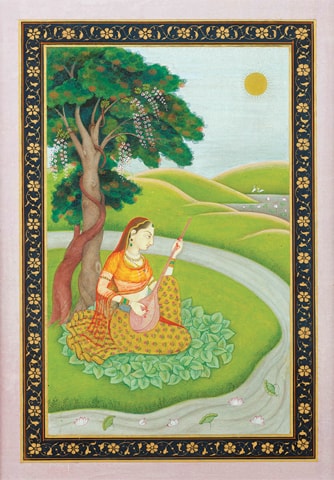
Her devotion to tradition is evident in her insistence on laboriously crafting the paper by hand and using natural dyes and pigments for her work. The execution is meticulous in its detail, with trees ornamented with indigenous flowers — most prominently the lotus — and the figures bejewelled. These features combine to create a world of its own, with a spiritual resonance and a sense of reverence and tranquility that moves throughout each piece. The graceful forms of Krishna and his devotees set against the rolling green hills seem to create a sanctuary for the subjects, the artist and the audience.
The artist seems to have used the miniature language to create a spiritual narrative, with a heavy focus on cultural motifs that add a sense of romanticism, but can also be perceived as deep symbolisms. The works seem to be tied together by a steady theme of longing, with exhibits such as ‘Offering’ and reverence bringing in a sense of loyalty, devotion and worship while ‘Remembering,’ ‘Moonlight,’ ‘Recollection’ and ‘The Garden’ create a sense of yearning. Although Radha and Krishna themselves feature in the works, they never appear together; even the ‘Union’ seems to speak of a more metaphorical sense of union. This perhaps alludes to the essence of the love story of Radha and Krishna instead of portraying a more canonised vision of it.
The works of Dr Marín’s show reverence to this traditional medium, displaying an exhaustive study of the style and mastery of skill which is rare to come by in recent times. The age-old tradition seems to come alive. However, with something that has already lived through its peak, one is left seeking an interpretation that doesn’t just excavate the past but rather incarnates its relevance within the present.
“One Source, Many Forms” was on display at the Koel Gallery from December 12 till December 23, 2017
Published in Dawn, EOS, January 14th, 2018