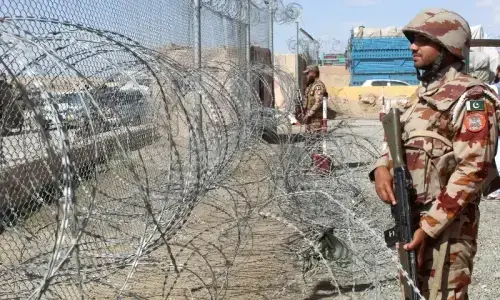
THE awfulness of the political shenanigans in Balochistan was bloodily underlined by yet another suicide attack in Quetta on Tuesday.
The jarring contrast between politicians arguing obscenely among themselves while militants are able to penetrate a so-called high-security zone and kill security personnel ought to give all sensible and right-thinking Pakistanis pause.
The newly resigned chief minister of Balochistan, Sanaullah Zehri, was no great democrat or governance maestro. Having forced his way into the chief minister’s office mid-term, Mr Zehri alienated many of his party and coalition colleagues.
Indeed, were it not for personal resentment towards him, PML-N MPAs and coalition allies may not have succeeded in creating an environment in which Mr Zehri’s resignation became inevitable.
Yet, it does appear that anti-democratic forces may have had a role to play in the latest political tumult in Balochistan.
Speculation that a no-confidence motion against the Balochistan chief minister would have been a first step towards a cascading crisis across the provinces and at the centre has refused to die down.
The PML-N’s national and provincial leaderships need to urgently work together to stabilise the political landscape in Balochistan and pave the way for Senate elections followed by a general election later this year.
With only months left until the end of the assemblies’ terms, it is unlikely that what two successive parliaments and Balochistan assemblies have failed to do can be engineered at this moment.
Yet, the security challenges in Balochistan have to be urgently reviewed.
Why have militants found it possible to strike inside ‘high-security’ zones repeatedly?
What has been learned from the attacks and what steps have been taken to prevent further incidents?
Has any official been held accountable for security lapses that have been identified?
Can Balochistan really be stabilised if war rages across the border in southern Afghanistan?
Some of the questions are old and ought to have been answered many years ago.
But political turmoil, especially of a kind that allegedly involves a role for the security establishment, renders any meaningful policy debate impossible.
It is remarkable that on the very day of a brutal suicide attack in Quetta, politicians were focused on their own, largely self-created political troubles.
Mr Zehri has failed and before him Abdul Malik Baloch of the National Party largely failed to live up to expectations.
Is there anyone in Balochistan who can bring political stability now?
Published in Dawn, January 11th, 2018