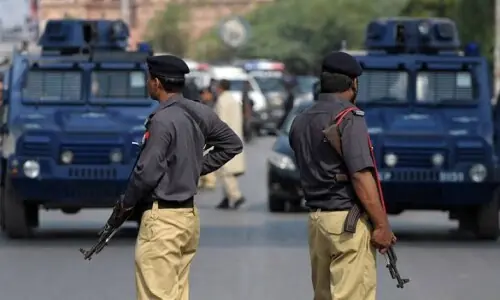
THE capital of the most militarised province in the country has been attacked yet again by terrorists. The Bethel Memorial Methodist Church in Quetta was attacked yesterday by suicide bombers; at least nine people were killed and many more injured. An attack almost certainly meant to spread fear countrywide among a beleaguered Christian community preparing to celebrate Christmas, the state has responded in a disturbingly reflexive manner by praising security personnel at the scene of the attack for preventing a greater attack. While heroic and alert security personnel may have prevented a greater tragedy, the attackers were undeniably successful. Indeed, the recurring question of how secure zones in Quetta are entered with seeming ease by militants remains unanswered. Quetta is neither a border town nor a provincial city with a scarcity of security resources. Perhaps state officials are concerned about maintaining morale among the general public and in the lower tiers of the security apparatus, but the denial of reality can have its own debilitating effects.
While the roots of terrorism in Balochistan are undeniably complex, there has been a tendency to try and separate it from militant violence elsewhere in the country. Certainly, a low-level nationalist insurgency and an unstable border with two neighbouring countries put Balochistan’s security challenges in a different perspective, but terrorist attacks such as against a church in Quetta cannot be separated from the national militant threat. From Fata to Karachi, Peshawar to Quetta and Rawalpindi to Lahore, there may be different militant networks active, but they are often part of the same spectrum. The interconnected fight against militancy and extremism also plays its part, with militant networks acquiring the knowledge to attack in new parts of the country by tapping into local extremist networks. The ad hoc, piecemeal strategy of the state to combat militancy, terrorism and extremism has not worked. Arguably, an ad hoc, piecemeal approach by the state allows militant groups to regenerate or evolve.
While state officials will pledge to step up security at churches and Christian sites across the country in the run-up to Christmas, the reality is that the terrorists will always have a greater range of targets. The Easter Sunday bombing in Lahore in 2016 targeted a public park frequented by local communities celebrating. It ought to be obvious that attacks must be stopped at the stage of conception and organisation if ever true stability and normality are to return to Pakistan. Unhappily, the state appears to be caught in a defensive crouch, lashing out at real and perceived external enemies but unable to bring greater coherence and organisation to the fight against militancy. With an election on the horizon, the political class fiercely divided, and the civil and military facets of the state seemingly in conflict with each other, the months ahead could hold great danger.
Published in Dawn, December 18th, 2017