0
0


When Mohammad Hafeez was suspended for the third time under the pretext of a suspect bowling action by the International Cricket Council (ICC) recently, it was merely another addition to the long list of players whose careers have been clouded by controversies.
Hafeez is not the first player to face such a dilemma. His compatriots Saeed Ajmal, Shabbir Ahmed and Shoaib Akhtar, along with West Indies duo of Sunil Narine and Shane Shillingford, current New Zealand skipper Kane Williamson, Zimbabwe’s Prosper Utseya, Sachithra Senanayake of Sri Lanka and South Africa’s Johan Botha, have all fallen victims to this malady.
The list certainly does not end there. Ever since the ICC chief executives’ moot in Melbourne in June 2014 recommended that the law pertaining to the process for reporting, assessing and clearing suspect bowling actions and powers to deal with the monitoring of suspect actions beyond the conclusion of the formal testing needed to be expanded, more and more cases have come to the surface.
The crackdown against suspect bowling actions has hit off-spinners the most
FAKE DEGREES?
It was in 2014 when Ajmal’s glittering international bowling career came to a grinding halt after the affable off-spinner from Faisalabad was found bending his elbow up to 43 degrees — almost three times more than the accepted 15 degrees during Pakistan’s Test tour of Sri Lanka, while his doosra had an extension of 42 degrees, the off-breaks 43 degrees and his quicker deliveries were deemed illegal at 39 degrees.
But what baffled most was that in 2009 Ajmal had been reported and cleared after undergoing extensive medical tests that revealed an elbow injury.
This is an ephemeral narration of what actually forced the ICC to come down hard on bowlers using illegal means to sustain their dominance in the game. Umpires nowadays are more vigilant than ever in their interpretation of the ICC rules and regulations. As a result, off-spinners have become vulnerable because they are the ones who are often labelled as using unfair tactics, particularly when they resort to deliver the doosra delivery, which requires bending of the elbow to bowl it successfully as Ajmal found out to his dismay.
And although Ajmal, a late entrant on the big stage at the age of 32, made a brief comeback in international cricket after undertaking remedial work with Saqlain Mushtaq, he was never able to rediscover the skill which had tormented so many batsmen in his prime.
Saqlain, of course, was a class act throughout his wonderful career that saw him claim 496 international wickets — 208 in just 49 Tests and another 288 in 169 One-day Internationals — between 1995 and 2004 before his playing days were blighted by injuries, notably to his knees.
But Saqlain was regarded as the authenticated inventor of the doosra — an off-spinner’s delivery which actually spins like a leg-break.
A HAIR-RAISING EXPERIENCE
To his credit, Saqlain’s smooth bowling action was never questioned unlike Muttiah Muralitharan, the Sri Lankan off-spinning wizard whose career was beset by controversies chiefly because he possessed an unusual hyperextension of a bent arm — courtesy of a deformity from birth — during his delivery stride.
Muralitharan, who hung up his boots in July 2010 after picking an incredible 800 wickets from only 133 Tests to add to his 534 victims in 350 ODIs, made worldwide headlines when Darrell Hair, the controversial Australian umpire, called him for throwing during the Boxing Day Test in 1995 from his position at the bowler’s end, although it is the square-leg umpire’s duty to adjudicate the legitimacy of the bowling action.
The situation got out of hand when Hair no-balled Muralitharan seven times in the space of three overs, forcing an outraged Sri Lankan captain Arjuna Ranatunga to leave the field in protest at what he termed as a discriminatory action from the Australian official.
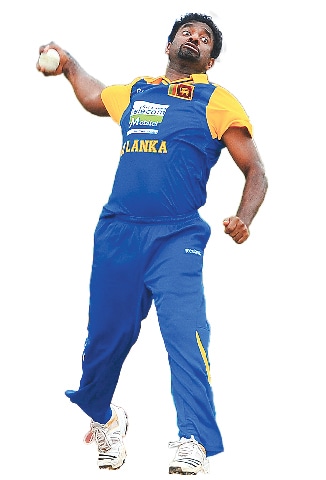
Ross Emerson, another Aussie umpire, emulated Hair three years later when he no-balled Muralitharan during a one-day match against England in Adelaide. The matter took a turn for the worse when a protesting Ranatunga confronted the umpire and subsequently led his team off the field for a while.
Long after his retirement, Emerson, now 63, even had the audacity to say that Muralitharan didn’t deserve the records he holds both in Test and ODI formats. “I haven’t changed my view in 15 years — he doesn’t deserve the record,” he told Sydney’s Daily Telegraph in a July 2010 interview. “You couldn’t compare his record to Shane Warne’s — no one ever doubted the legality of Warne’s action. Murali was a great competitor and a great bowler but a lot of the time he just didn’t bowl within the limits of the law.”
Muralitharan, who was cleared by the ICC after biomechanical tests were carried out at two separate universities in Perth and Hong Kong in 1996, remained under scrutiny for most of his career because of his freakish style of bowling.
THROWING IT ALL AWAY
While Muralitharan was easily the most notable ‘victim’ of this malaise suffered by off-spinners in general, there were instances in cricketing history where the bowlers of other types met their Waterloo. The current generation may not even have heard of Geoff Griffin or Ian Meckiff.
Griffin was a right-arm fast bowler who made just two Test appearances and is the only South African to take a Test hat-trick, but never played for his country after being called for throwing during the Lord’s Test of the 1958 series in England.
Ever since the ICC chief executives’ moot in Melbourne in June 2014 recommended that the law pertaining to the process for reporting, assessing and clearing suspect bowling actions and powers to deal with the monitoring of suspect actions beyond the conclusion of the formal testing needed to be expanded, more and more cases have come to the surface.
Meckiff, also a pace bowler, earned fame as well as notoriety for pure cricketing reasons. The Australian was the last man to be dismissed in the gripping Gabba game in December 1960 when West Indian Joe Solomon ran him out with a direct hit to produce the first-ever tied Test.
But three years on, Meckiff’s 18-Test career met an abrupt conclusion in Brisbane when umpire Colin Egar called him four times in the only over he bowled during the first Test against South Africa.
Haseeb Ahsan was the first Pakistani to be called for chucking during the first Test of the 1960-61 series against India at Bombay (now Mumbai). An off-spinner who had the knack of turning the ball prodigiously, Haseeb’s international career ended on a controversial note while touring England in 1962 amidst conflicting reports of either falling-out with Pakistan captain Javed Burki or that fears of being called for throwing with his jerky action had compelled him not to play any Test on that tour.
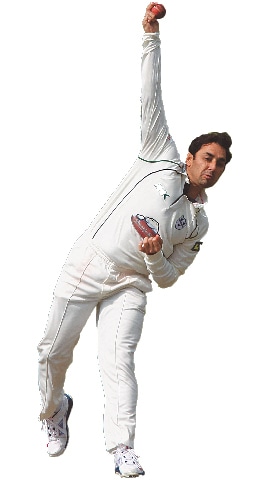
Haseeb, who took 27 wickets in 12 Tests, is also remembered as the man who discovered Wasim Akram in his tenure as the chairman of selectors in 1984.
MUCH ADO ABOUT NOTHING
Shoaib Akhtar, affectionately dubbed as the ‘Rawalpindi Express’, is acclaimed as one of the fastest bowlers to play the game. Statistically speaking, he never reached the heights attained by his contemporaries, Wasim Akram and Waqar Younis, but he was feared most by the batsmen for his sheer pace.
Shoaib, a colourful personality, courted controversy when during the tour of Australia he was called for throwing in December 1999. But tactful handling of his case by the Pakistan Cricket Board’s regime of Lt Gen Tauqir Zia, forced the ICC to overturn the ban.
BACK TO THE DRAWING BOARD
Shabbir Ahmed didn’t have the same luxury as Shoaib. After being twice censured for throwing in 1999 and 2004, the gangly speedster from Khanewal was slapped with a 12-month ban in December 2005 after being reported for the second time that year for a suspect bowling action during the Multan Test against England.
The ICC crackdown on illegal bowling actions at the international level had even spread to domestic cricket. Months after the Ajmal ban, the PCB, in their endeavour to avoid further embarrassment, went overboard during the season by suspending no less than 29 bowlers for suspect actions.
The National Cricket Academy in Lahore was the place where those players were sent for corrective measures since the board-owned biomechanics laboratory’s equipment was still lying idle after seven years. The lab only became functional last year after it was handed over to LUMS for a three-year period.
TAG, YOU’RE IT
It is not just the male cricketers who received the unwanted tag. In 2010, Javeria Wadood, better known for her batting exploits, became the only Pakistani female player, thus far, to be reported for a suspect bowling action during the ICC World Twenty20 event. Javeria was reported to have exceeded the 15 degrees limit while bowling off-spin during Pakistan’s match against Sri Lanka at Basseterre in St Kitts.
The only other woman cricketer to be suspended for an illegal bowling action is India’s Snehal Pradhan, during an ODI against England at Derby in 2011.
Generally speaking, off-spinners are getting extinct in the aftermath of the ICC’s crackdown. The doosra — especially in limited-overs formats — has gone out of fashion, and trying to master the art has one facing the consequence of either a suspension or a ban.
Nathan Lyon is the most successful off-spinner in Australia’s history and the reason of his survival is that he hails from the old school of thought and never tries anything preposterous while bowling. Before Lyon’s arrival, there were several world-class exponents of the now vanishing art. Jim Laker, Hugh Tayfield, Sonny Ramadhin, Lance Gibbs, Erapalli Prasanna, Srinivas Venkataraghavan, Saqlain, Harbhajan Singh and Graeme Swann were among the best.
Ravichandran Ashwin, who the other day became the quickest to the 300-wicket mark in Test cricket, has a carrom ball which at times is delivered with a questionable action. But ICC’s leaning towards India means Ashwin — for obvious reasons — is unlikely to get into trouble like the rest.
The writer is a member of staff
Published in Dawn, EOS, December 3rd, 2017