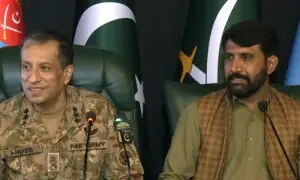
AFTER its formation was first announced nearly two years ago, the inaugural meeting of the Islamic Military Counter Terrorism Coalition’s Ministers of Defence Council is scheduled to take place tomorrow in the Saudi capital Riyadh. Optimists have dubbed the Saudi-led outfit the ‘Muslim Nato’ while critics have described it as a ‘phantom army’. Indeed, many across the Muslim world — particularly in Pakistan as this country’s former army chief Raheel Sharif heads the alliance — will be watching Sunday’s proceedings from Riyadh keenly to try and ascertain the exact shape and form the outfit takes. Until now, there has been mostly opacity surrounding the coalition, particularly its raison d’être. Both the Saudis and the government here have only issued vague generalised statements about why the coalition has been set up. As a press statement giving details of the upcoming meeting put it, the IMCTC seeks “to fight all forms of terrorism and extremism. ...”
Fighting terrorism is a noble goal and indeed — especially where the Muslim world is concerned — an existential need. As Friday’s horrific tragedy in Egypt has shown, the militant bands that roam the Middle East and its peripheral regions are still very much capable of mass slaughter. While the militant Islamic State group and other such concerns may be on the verge of defeat in Syria and Iraq, elsewhere branches of the terror outfit, such as in Sinai and other regions, pose a considerable challenge. Hence, a viable counterterrorism coalition of Muslim states that can share resources, funds and expertise can do much to cleanse the region of such killers. Yet the problem with the Saudi-led coalition is that rather than being an inclusive anti-terrorism alliance, it smacks of partisanship. Proof of this lies in the fact that while the IMCTC claims to have 41 Muslim states in its ranks, this list does not include Iran, Iraq and Syria. It is baffling why such major Muslim states have been left out unless, of course, this has been done deliberately on sectarian grounds.
Saudi Arabia, especially under the watch of its ambitious crown prince, has adopted an aggressive policy towards many regional states, including Iran. While the Saudi-Iranian rivalry is over three decades old, the vitriol of the past few months has been especially toxic. For example, on Friday, so close to the IMCTC meeting, the Saudi crown prince dubbed Iran’s supreme leader “the Hitler of the Middle East”. If the prince’s comment is any indication of the type of tone the IMCTC meeting may adopt, there is reason for concern. Pakistan made the right decision by choosing not to participate in the Yemeni quagmire despite Saudi pressure. If the IMCTC turns out to be a Saudi platform to bash geopolitical enemies and advance sectarian narratives, then this country would best stay away from such a misadventure.
Published in Dawn, November 25th, 2017