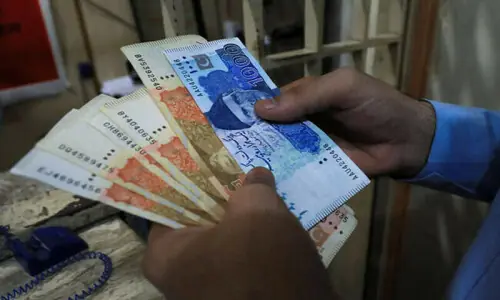
THE number of Pakistani workers going to the six-nation Gulf Cooperation Council (GCC) is on the decline, fuelling fears of a consequent fall in remittances from there, particularly at a time when the entire region in general and Saudi Arabia in particular is undergoing dramatic political and economic changes.
Pakistan’s remittances from the GCC — a regional union comprising Bahrain, Kuwait, Oman, Qatar, Saudi Arabia and the United Arab Emirates (UAE) — started growing rapidly from 2002, partly owing to post-9/11 developments and increased manpower export to that region.
But from 2014, our manpower export to the UAE, the largest market of the Pakistani workforce, has been on the wane. And from 2015, the same has been the case with Saudi Arabia, the second largest market.
Besides, as Saudi Arabia is now reshaping with its fiscal policies and expanding non-oil economy and as the UAE is fast emerging as a global business centre, the dynamics of manpower exports are also changing.
Though Pakistan has not yet experienced any major setback in remittances’ flow from these two countries, some signs of weakening are quite visible now.
As Saudi Arabia, UAE and other GCC nations are reshaping their economies, future inflows would depend on the quality of our manpower export
If we look at annual remittances from Saudi Arabia, no big change has occurred in the past five years despite the fact that our manpower export to that country has seen a declining trend after 2015.
A major reason is that remittances coming from the more than two million Pakistanis already working in the kingdom and fluctuations in manpower export for one or two years cannot majorly disturb remittances.
However, 2017 is unique because during the first nine months of this year our manpower export to Saudi plunged to less than 25 per cent of what it was in 2016. Such a big decline is bound to affect the inflows from there.
The monthly average of remittances from Saudi Arabia fell to $443m in January-October this year from $484m a year ago. The impact of an even larger decline this year would reflect accordingly in next year’s remittances.
The 2018 remittances from the kingdom may also reflect a fuller impact of the July 2017 levy under which a tax of 100 riyals (Rs2,800) per month was imposed on each unemployed family member of foreigners living in the kingdom.
Many Pakistanis unable to afford this tax have started coming back home, and those who would prefer living there would obviously not be able to send as much foreign exchange as they did before the levy.
Pakistan has sought concession in this tax for its citizens living in Saudi Arabia, but it is difficult to predict whether the Saudi government can grant it.

Moreover, the kingdom’s recent decision to allow its women to drive might also affect Pakistani workers, a large number of whom are drivers, thus affecting the flow of remittances to Pakistan.
In the nine months through September, our manpower exports to the UAE also fell but less steeply than in the case of Saudi Arabia. Besides, many Pakistanis who go to the UAE for jobs find opportunities of doing their own part-time business far easily than in Saudi Arabia.
That is why remittances from the UAE declined just 2pc in the last calendar year. And in January-October this year, average monthly remittances from there improved to $396m compared to about $361m a year earlier.
However, remittances from the UAE may also start falling if the government gets more serious in tracking down an estimated $8 billion investment from resident Pakistanis in the emirates’ real estate market.
“One reason why UAE’s remittances may not falter too much despite falling manpower export is that part of the inflows are proceeds of the transactions made in Pakistanis’ real estate investment in Dubai,” officials of exchange companies say.
Another thing that may offset a declining trend in remittances from the UAE is that many Pakistanis previously settled and employed in the United States, Britain or Canada have shifted to the UAE.
Cumulative remittances from the remaining GCC nations — Bahrain, Kuwait, Qatar and Oman — kept growing for a long time, but fell marginally to $2.325bn in 2016-17 from $2.423bn in the preceding year. A similar trend remained in sight in the July-October period this year, a look at recently released data reveals.
Our cumulative manpower export to these countries fell to 53,032 in January-September this year from 63,787 in the entire 2016 and 69,722 in 2015.
The lifting of the ban in 2016 on manpower exports to Kuwait has yet to make any significant impact, despite tall claims of the government.

Declining manpower exports combined with fewer opportunities of work for overseas Pakistanis living in these countries, each one focusing on promoting jobs for local population or on revisiting policies of foreign workers’ hiring at a time of low oil prices, may keep inflows to Pakistan lower, bankers say.
One important determinant of the volumes of remittances from the GCC region, or from anywhere else for that matter, is the quality of our manpower exports. Our record is poor on this count. In January-September this year, fewer than 1,800 professionals (engineers, doctors, nurses, teachers, accountants and managers) went abroad for jobs compared to 45,484 drivers and 155,556 labourers.
As Saudi Arabia, UAE and other GCC nations are reshaping their economies, much would depend on the quality of our manpower exports there in determining future remittances.
Published in Dawn, The Business and Finance Weekly, November 20th, 2017