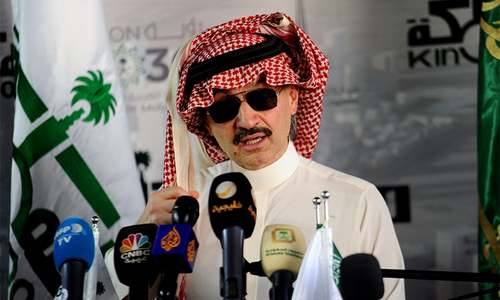
FOLLOWING the rapid ascent of Mohammed bin Salman to the second-most powerful position in Saudi Arabia, a series of unprecedented changes have occurred in the desert kingdom.
The young crown prince — seen as the actual power behind the throne — had earlier announced that resort islands off the Red Sea coast would be developed, where the strict religious laws of the kingdom would not apply. He had also recently said that the ban on women drivers would soon be phased out.
And the latest in this series of declarations came on Oct 24, when the prince announced the launch of NEOM, a $500bn mega project on Saudi Arabia’s north-western tip. Bin Salman has dubbed this bizarre dream “the first capitalist city in the world. ...” where Saudi law will, again, not be applicable.
Along with these futuristic visions, the crown prince has talked of returning his country to ‘moderate Islam’.
Read: Mohammed bin Salman — a profile
From these pronouncements, it appears that bin Salman is embarking on a nation-building project, using a mix of social engineering and authoritarianism to fashion a new, ‘liberal’ Saudi Arabia.
However, some things must be considered if the Saudi establishment is serious about changing direction.
Firstly, opening nightclubs, beach resorts and allowing concerts, yet at the same time smothering all dissent and criticism, does not translate to a liberal setup.
While the prince has announced these ambitious projects, his government has also intensified repression of critics, real and imagined. Over the past few months, clerics, activists and members of civil society have been rounded up by the security apparatus. Even some dissenting members of the royal family have reportedly been detained.
For a truly pluralistic sociopolitical setup, people must be allowed to criticise their government, assemble peacefully and discuss ideas openly without fear. Secondly, it is a fact that at its core Saudi Arabia remains a tribal, conservative society.
Explore: A kingdom in transition
Therefore, any attempts at change must be incremental and, most importantly, should take the population on board. It should be remembered that the 1979 seizure of Makkah’s Masjid al-Haram by religious zealots was triggered by their apprehensions that the House of Saud was not ‘pious’ enough.
Much of Saudi society — mainly because of the royal family’s patronage of hard-line clerics and their influence on the education system — may resist high-speed changes that threaten to undo social and religious structures. Therefore, for the sake of stability, the Saudi rulers need to progress steadily but carefully.
Published in Dawn, October 29th, 2017