Catalonia woke up on Saturday under the direct control of Madrid as the Spanish prime minister took drastic measures to quash secession, deposing the region's leaders and dissolving its parliament hours after lawmakers declared independence.
In a dramatic escalation of a political crisis that has stoked alarm in Europe and sent shockwaves through Spain, Mariano Rajoy also decided to call snap Catalan elections on December 21 to “restore normality” to a region in turmoil.
Catalan President Carles Puigdemont and the 12 members of the Catalan Cabinet will no longer be paid and could be charged with usurping others' functions if they refuse to obey.
There was no immediate response from the top Catalan officials. Only the director of the Catalan regional police, who was also fired, issued a statement saying he would comply.
In the Spanish capital, protesters were due to hit the streets on Saturday against Catalonia's declaration of independence, which while lacking any legal basis has caused strife in a region deeply divided on whether to split from Spain.
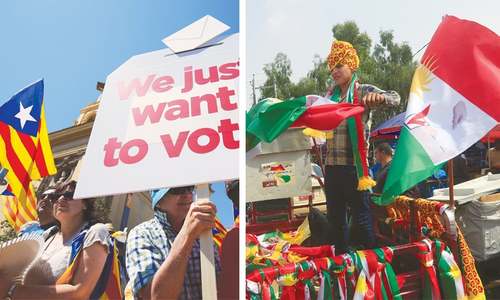
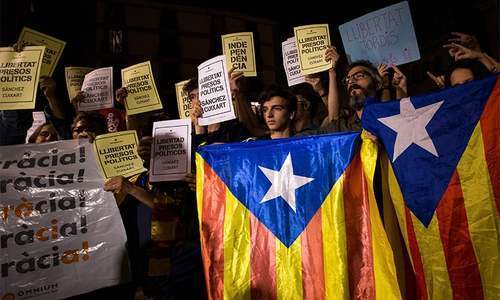
On Friday in Barcelona and other Catalan cities, thousands celebrated their regional parliament's motion for independence, which passed with 70 votes for, 10 against and two abstentions in a 135-seat chamber that anti-secession MPs had deserted in protest.
Demonstrators in Barcelona broke out in ecstatic shouts of: “Independence!” as the result was announced, while separatist MPs cheered, clapped and embraced before breaking out in the Catalan anthem.
But others glumly assessed the fallout to what they viewed as a hugely damaging and illegal vote. “They're forgetting part of the people, the majority,” said Josep Reina, a 34-year-old salesman.
Fears of unrest
The move to take over Catalan powers is likely to anger many in a region of some 7.5 million people that enjoyed considerable autonomy, with control over its education, healthcare and police.
It is the first time that the central government has curtailed regional autonomy since dictator Francisco Franco's repressive 1939-75 rule.
Independence supporters have warned they will resist the temporary measure, implemented under Article 155 of the constitution, devised to rein in rebel regions.
“We won't cave in to Rajoy's authoritarianism nor to 155,” tweeted the far-left CUP party, an ally of Puigdemont.
The resistance could come in the form of street protests and strikes, all of which have already happened since October 1 when an outlawed independence referendum was marred by police violence as central authorities tried to stop people from voting.
Catalan leaders hold up the unregulated referendum that had been banned by the Constitutional Court as a mandate for independence, saying 90 per cent voted “Yes” even if only 43pc of voters turned out.
Federico Santi, Europe analyst at political risk consultancy Eurasia Group, warned there could be “more serious clashes between national police and pro-independence activists,” echoing widely-held fears.
Speaking after the parliament proclaimed an independent republic, Catalan leader Carles Puigdemont urged activists to “maintain the momentum” in a peaceful manner.
Other measures adopted by the government include the dismissal of the director of the Catalan regional police force, the Mossos d'Esquadra, as well as Catalan government representatives in Madrid and Brussels.
Deputy Prime Minister Soraya Saenz de Santamaria is due to meet on Saturday with secretaries of states, who will likely take charge of Catalonia's regional ministries.
The Spanish government has received unwavering support from his European allies and the United States.
The European Union in particular is wary of nationalistic and secessionist sentiment, particularly after Britain's dramatic decision last year to leave the bloc.
EU President Donald Tusk insisted Madrid “remains our only interlocutor” in Spain.
But he also urged Madrid to exercise restraint, tweeting: “I hope the Spanish government favours force of argument, not argument of force.”