KOHAT: Provincial minister for education Mohammad Atif Khan has approved upgradation of 30 schools to the next level up to high in Kohat and Swabi as a pilot project to control dropout rate in the far-flung areas.
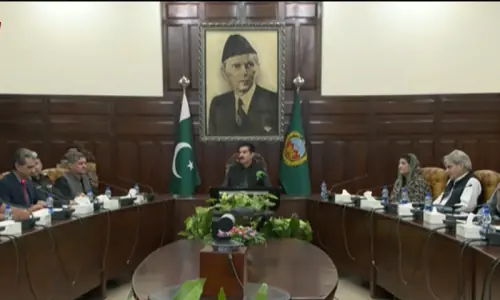
Addressing the launching ceremony of STRIDE programme here at the Comprehensive High School, he said that the project of upgradation had been initiated with the help of the Institute of Social and Policy Sciences and Elementary and Secondary Education Department.
He stated that the students would be accommodated in the second shift which had been started with immediate effect in 30 schools. He distributed transport cards among the students.
The minister said that the project would be expanded to other districts soon and no area would be left where children suspended their education due to absence of higher schools. These schools would be upgarded from primary to middle and high. He said that the students of remote areas would be provided with cycles and transport cards to avail of free of cost travel.
Mr Atif said that they had employed 40,000 teachers, while 16,000 more would be appointed in the next few months.
The function was attended by secretary information Qaiser Alam, MPA Ziaullah Bangash, district education officer Haziqur Rehman, district nazim Naseem Afridi and STRIDE programme executive director Dr Suleman Hamayun.
The minister said that when they took over government there were only 179 schools which had got IT labs, but now the number of such schools had increased to 1,350 and by end of the year all the schools would have the facility. He said that 83,000 teachers were being trained with the help of British Council.
Meanwhile, District Awaz Forum (DAF) in a meeting urged the Nadra to reach out the areas where the process of registration of identity cards was very slow.
DAF member Hazrat Begum said that she knew about several cases where the identity cards had been blocked and despite several meetings with Nadra officials the issue could not be resolved. The meeting identified Sodal, Shakardarra and Sherkot where there was need of attention by Nadra.
Published in Dawn, October 27th, 2017