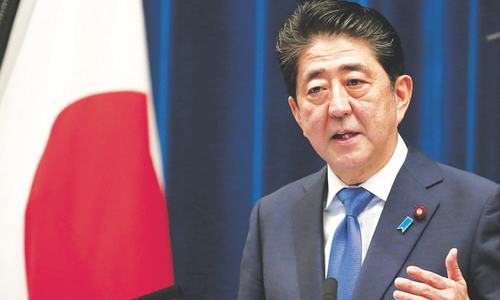
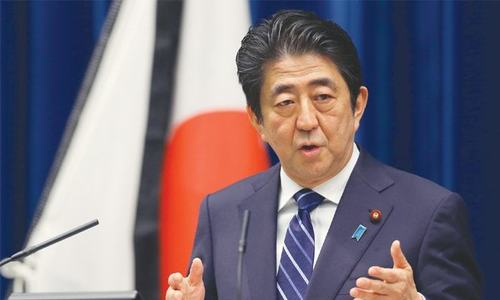
Millions of Japanese braved typhoon conditions on Sunday for a snap election likely to hand Prime Minister Shinzo Abe a fresh mandate to revive the world's third-largest economy and press his hardline stance on North Korea.
If pre-vote surveys prove correct, Abe's conservative coalition will cruise to a crushing majority to win a fresh term at the helm of the key US regional ally and Asian economic powerhouse.
Polling stations opened at 7:00am (2200 GMT Saturday) with voters battling high winds and driving rain as an election-day typhoon barrelled towards Japan.
Despite the bad weather, voter turnout excluding early voting rose to 12.24 percent by 11:00am from 11.08 percent in the previous election three years ago, while a record 15.64 million had cast early votes by Friday, the government said.
Analysts earlier said low turnout would likely benefit Abe, who is aiming to become the country's longest-serving leader.
“I support Abe's stance not to give in to North Korea's pressure,” said one voter, Yoshihisa Iemori, as he cast his ballot in Tokyo.
“I'm focusing on this point for the election,” the 50-year-old construction firm owner told AFP.
Near-constant drizzle throughout the campaign has not dampened the enthusiasm of hundreds of doughty, sash-wearing parliamentary hopefuls, who have driven around in minibuses pleading for votes via loudspeaker and bowing deeply to every potential voter.
But with little doubt over the eventual result, the suspense lies in whether Abe's Liberal Democratic Party (LDP) and its junior coalition partner will retain its two-thirds majority in the lower house.
Such a “supermajority” would allow Abe to propose changes to Japan's US-imposed constitution that forces it to “renounce” war and effectively limits its military to a self-defence role.
Ballot boxes close at 8:00pm (1100 GMT) when broadcasters publish generally reliable exit polls.
Powerful typhoon Lan has already caused landslides and delayed voting at one polling station, while commuter boat services of a remote island in western Japan were cancelled due to high waves, forcing election officials to give up counting islanders' votes on Sunday.
'We must not waver'
Abe shocked Japan by calling the election a year earlier than expected, urging voters to stick with him in the face of what he termed the dual “national crises” of an ageing population and North Korean tensions.
Pyongyang has cast a menacing shadow over the short 12-day campaign, after it lobbed two missiles over the northern island of Hokkaido and threatened to “sink” Japan into the sea.
“When North Korea is purposefully threatening us and increasing tension, we must not waver,” an animated Abe stressed at his final campaign rally.
Observers say North Korea's sabre-rattling has helped Abe, 63, as voters tend to favour the incumbent at times of heightened tension.
'Morals collapsed'
Despite a clear lead in the polls, Abe enjoys only lukewarm support in Japan and critics say he called the election to divert attention from a series of scandals that dented his popularity.
Voter Etsuko Nakajima, 84, told AFP: “I totally oppose the current government. Morals collapsed. I'm afraid this country will be broken.”
“I think if the LDP takes power, Japan will be in danger. He does not do politics for the people,” added the pensioner.
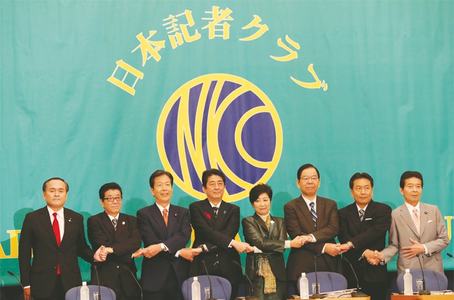
But Abe faces a weak and fractured opposition in the shape of two parties that have only existed for a few weeks, the Party of Hope created by Tokyo Governor Yuriko Koike and the centre-left Constitutional Democratic Party.
Koike, 65, threatened to shake up Japan's sleepy landscape with her new party, vowing to do away with old-school politics and vested interests.
But after days of wall-to-wall media coverage for the former TV presenter, the bubble burst and Koike's popularity ratings plunged, mainly because she declined to run herself in the election.
“As it turned out, the Party of Hope is hopeless,” said Michael Cucek from Temple University.
Koike was not even in Japan on election day, choosing to visit Paris for an event in her capacity as Tokyo Governor.
The centre-left Constitutional Democratic Party may benefit from her decline and could become the second biggest party.
Abenomics: limited impact
Despite the threat from North Korea, many voters feel the economy is a more pressing issue, as the prime minister's trademark “Abenomics” policy has had limited success in returning Japan to its former glories.
“Neither pensions nor wages are getting better... I don't feel the economy is recovering at all,” said 67-year-old pensioner Hideki Kawasaki.
Abe has vowed to use part of the proceeds from a proposed sales tax hike to provide free childcare in a bid to get more women working but Koike wants to scrap the hike altogether.