

Sex attacks leave Rohingya children fearful in Bangladesh’s camps
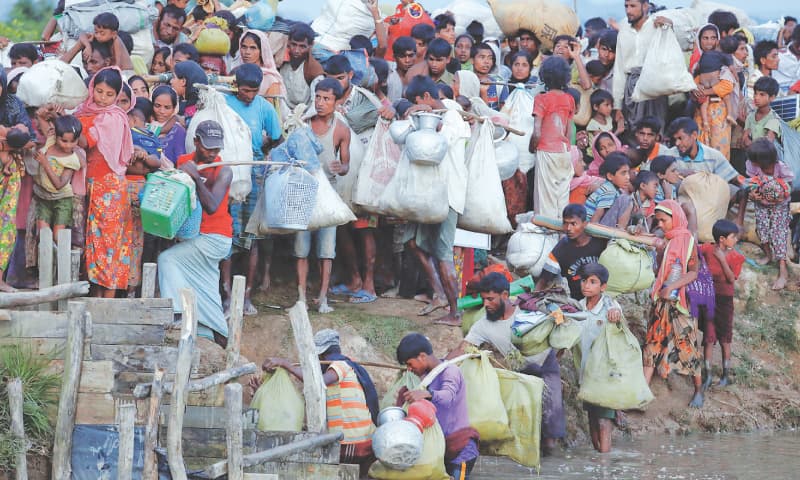
COX’S BAZAR: Thirteen-year-old Adjida, a Rohingya Muslim girl, kicked and screamed when the rough and dirty hands of the masked soldier ripped off her clothes.
She pleaded with him to stop when he, with a gun in one hand, raped her.
Just minutes before, Adjida had watched her parents being shot dead from her hiding place under a wooden table in a village in Myanmar’s western state of Rakhine. She tried to run into the surrounding jungle, but was captured by a soldier.
The home of the teenager was torched in the attack in Kawarbil village six weeks ago by Myanmar army soldiers, she said, and she and her sister fled with other villagers across the border to Bangladesh.
But the threat of sexual violence for children like Adjida has not diminished since reaching the sprawling refugee camps near Bangladesh’s Cox’s Bazar — home to hundreds of thousands of newly arrived Rohingya who have fled violence in Myanmar.
More than 800 incidents of gender-based violence have been reported by Rohingya refugees since the recent influx, said Unicef’s head of child protection Jean Lieby. Over half of these cases are sexual assaults, according to the UN agency.
Some 515,000 Rohingya have arrived in Bangladesh in an unrelenting movement of people that began after the Myanmar army responded to Rohingya militant attacks with a brutal crackdown.
The UN has denounced the Myanmar military offensive as ethnic cleansing but Myanmar insists its forces are fighting “terrorists” who have killed civilians.
About 60 per cent of the new arrivals are children. Adjida arrived with her 15-year-old sister Minara a month ago. The sole survivors of their family, they live by themselves in a tent made of bamboo and plastic sheeting in Kutupalong camp.
They don’t feel safe.
“Our parents and two older sisters were killed and they can’t take care of us anymore. Here in the camp, we have already heard of other girls who were raped in the last days, that’s why we try to stay in our tent most of the time,” Minara said.
Trauma
The girls agreed to speak to the Thomson Reuters Foundation in an empty classroom of one of the camp’s school buildings, but asked for windows to be closed and that they not be identified by their full names.
The girls covered their faces with their headscarves and asked for assurances no men would be allowed into the room.
“I’m ashamed of what happened. I had many dreams for the future, but they are lost with my purity,” said Minara, who was also raped as she tried to escape from her village.
“I don’t have enough clothes to fully cover, but it’s what I want to do now,” she said, nervously fidgeting with the embroidered black dress she had borrowed from a neighbour.
Aid agencies have set up safe spaces in Kutupalong camp — colourful rooms or outside areas — where women and children who are victims of sexual assault can find counselling and support.
“They feel comfortable and understood here and it’s often the first time they open up and talk about their trauma,” said UNFPA spokeswoman Veronica Pedrosa.
But there is not enough help for the overwhelming numbers who have arrived in such a short time.
“We just had a month of unprecedented refugee influx and it’s nothing like Bangladesh has seen before. Almost half a million people arrived,” said Lieby of Unicef. “We are now working hard to scale-up and meet the needs of refugee children. We especially ... want to change the stigma that comes with rape.”
Stigma
Even with counselling services available, many girls still opt not to report that they have been raped, said aid workers in the camp.
“In an environment like this, girls are often scared of the stigma attached to sexual violence. They also fear their family’s opinion,” said Rebecca Duskin, a nurse focusing on sexual violence in Kutupalong.
Working for the health charity Medical Teams International, she has come to the camp to set up a disease prevention clinic.
“This is often the first sexual encounter for the victims and they need a safe place to turn to now,” she said. “They have experienced violent rape in a conflict zone and often in public, which increases trauma.”
Kutupalong’s new refugees have arrived exhausted, hungry and often with physical injuries such as machete or gunshot wounds. But it is the psychological trauma that runs deepest.
“I’d rather die here than go back home,” said Minara. “We barely go outside. There are no more guns here, but there are people who could rape us again.”
Her younger sister Adjida, sitting next to her, agrees.
“I thought I was going to die when the soldiers took us to the jungle. Now I know I would have preferred to die. It’s better than losing my purity.”
Thomson Reuters Foundation
Published in Dawn, October 10th, 2017




























