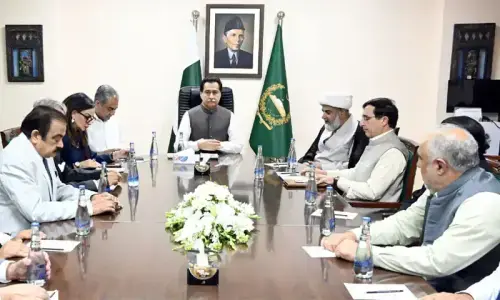
In the context of the current, arguably cynical and calculated backlash, the comments are perhaps appropriate. In the context of long-term challenges that state and society will inevitably have to confront, they are inadequate. Interior Minister Ahsan Iqbal has rightly denounced elements that have threatened to declare jihad inside the country in recent days and emphatically asserted that only the state has the right to issue a call to arms.
The interior minister’s comments echoed what has been asserted by Gen Qamar Bajwa recently, the army chief having publicly stated that the state must have a monopoly over violence and is the sole authority to declare jihad.
That the state is finally willing to push back publicly and firmly against extremist elements that not only reject the Constitution but also want to unleash violence inside Pakistan is a welcome change. A better future for all Pakistanis will not be won without confronting regressive groups operating inside the country.
Yet, there are two problems with the formulation that the interior minister has chosen. First, it does not acknowledge the role that the state itself has played in encouraging jihad among sections of the population and in regional conflicts. If there are groups and societal elements inside Pakistan willing to threaten jihad over all manner of perceived offences, virtually all of them have found encouragement at one point or another from the state itself to do so. The state has only gone so far as to recognise that sustained and sweeping counter-extremism efforts are needed across the country; little has been achieved or even attempted in practice.
The controversy that parliament has found itself mired in is an unfortunate illustration of the utter failure of the state to cleanse the public discourse of hateful rhetoric and its total failure to develop a national dialogue that is inclusive, rational and democratic. Are the elements urging violence today not a reflection of a state that unthinkingly and for long embraced ideas that are inimical to a modern, constitutional, democratic state?
Second, there is a fresh danger in the very idea that only the state can declare a certain kind of religiously mandated violence. For the state to protect itself and its people against external enemies, or to defend itself in the case of a declaration of war against Pakistan, there are thoroughly legitimate, legal and internationally accepted reasons for doing so that do not appeal solely to religious sentiment.
Where are these notions of a certain kind of religious edict being the exclusive domain of the state or necessary in any circumstances at all coming from? Instead of debating who has the authority to declare and wage jihad, the state ought to be working to ensure the total elimination of all non-state actors and militias. Pakistan must demonstrate that it is fundamentally committed to being a responsible member of a modern world order.
Published in Dawn, October 9th, 2017