A Myanmar minister on Monday proposed taking back hundreds of thousands of Rohingya Muslims who fled to Bangladesh after a military crackdown, said Bangladesh's top diplomat.
But no details of the planned repatriation were given by Bangladesh Foreign Minister A.H Mahmood Ali, and there was widespread scepticism over whether any of the more than 800,000 Muslim Rohingya now in Bangladesh would return.
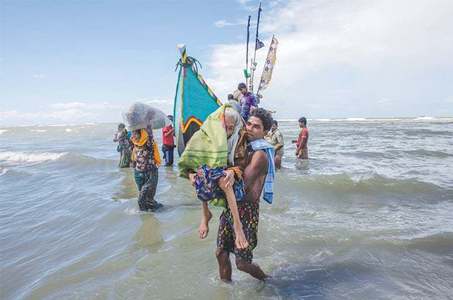
More than half a million have arrived over the last five weeks after militant attacks in Myanmar's Rakhine state sparked violent reprisals which the United Nations has said could amount to ethnic cleansing in the Buddhist-dominated country.
The talks between Mahmood Ali and Myanmar's Minister of the Office of State Counselor Kyaw Tint Swe came as UN representatives were given their first access to Rakhine since the trouble erupted on August 25.
UN officials, diplomats, and aid groups were taken on a one-day visit organised by Myanmar authorities. They were flown by helicopter to Maungdaw, an epicenter of the violence.
Mahmood Ali held what he called “friendly” talks in Dhaka with the representative of Myanmar's civilian leader Aung San Suu Kyi.
“Myanmar has made a proposal to take back the Rohingya refugees,” the minister told reporters. “The two sides have agreed to a proposal to set up a joint working group to coordinate the repatriation process,” he added.
Suu Kyi, who has been severely criticised for her failure to curb the military crackdown, said last month that Myanmar would take back “verified” refugees. This would be done according to criteria agreed in 1993, when tens of thousands of Rohingya were repatriated, she said.
The Bangladesh minister gave no timeframe for repatriation and did not say whether Myanmar would also take back 300,000 Rohingya refugees who fled to Bangladesh during the earlier violence. He said refugees would be verified by the joint working group, but without UN involvement.
“Bangladesh has proposed a bilateral agreement [with Myanmar] to help implement the repatriation,” he said. There was no immediate comment from Suu Kyi's representative, who was to return to his country on Monday.
Myanmar denies the Rohingya minority citizenship even though many have lived there for generations. It considers the Muslims as illegal migrants from Bangladesh.
No papers, no state
Myanmar's insistence on verifying the Rohingya could prove a “stumbling block” to repatriation, according to Shahab Enam Khan, an international relations specialist at Jahangirnagar University. “Myanmar has shown good initiative but their proposal is not adequate, particularly the verification is a non-starter,” he told AFP.
“The Rohingya fled to Bangladesh without any legal documents and it is difficult to prove their identity,” he added.
Mohammad Amin, who arrived in Bangladesh on Sunday with two neighbours in a rickety boat, said he would consider returning if their safety was guaranteed. “If they treat us as equals, we would go back,” he told AFP in a coastal town near the border.
Nurul Amin, a labourer who also arrived Sunday by boat with six of his family members, said they fled after Buddhist mobs threatened them with violence if they did not leave. If they accept us as Rohingya and said they would not harm us, we would return,” he told AFP at a refugee registration booth.
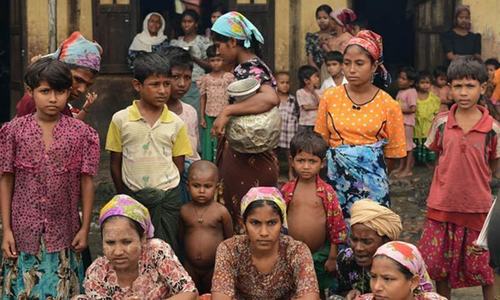
The refugees are packed into overcrowded UN and makeshift camps along the Bangladesh-Myanmar border. Aid groups have warned that epidemics could easily spread in the desperate conditions.
It remains unclear where the Rohingya would go if they were returned to Myanmar. Many of their villages have been burnt to the ground in the reprisal operations.
In a speech to the UN General Assembly last month, Bangladesh's Prime Minister Sheikh Hasina proposed creating UN-supervised safe zones inside Myanmar. Hasina accused Myanmar authorities of laying landmines on the border to prevent the Rohingya from returning and said the UN must find a solution to the crisis.