The question that bedevilled the last two American presidents appears to have bewildered the latest one too: what should the US do about Afghanistan?
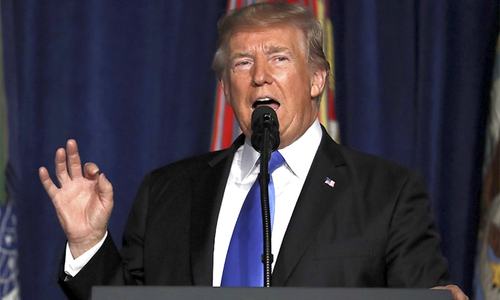
After months of internal debate, President Donald Trump has unveiled his administration’s strategy in Afghanistan; it is a mixture of the familiar, the tested and the failed. There are some important differences to the strategy former president Barack Obama had pursued.
There will be no timeline for an exit by US troops in Afghanistan. There will be looser rules of engagement for US troops, which will likely lead to more civilian casualties and fresh political turmoil. There will be an increase in covert operations, presaging an increase in tensions with Pakistan over tactical matters. And the possibility of dialogue with the Afghan Taliban has been discarded for the foreseeable future, once again exposing Pakistan to the US mantra of ‘do more’ without a sense that a political settlement is at hand.
For Pakistan, the challenge will be twofold: to not react emotionally to the American president’s invitation, unreasonable though it is, to India to have a greater role in Afghanistan; and to continue to focus on the national priority of progressively reducing the space for all manner of militancy, terrorism and extremism in the region.
It will not be easy. Mr Trump’s speech underlined that there will be no reset in relations with Pakistan; that the trend evident since the final years of the Bush administration will continue; and that ties will remain firmly transactional, with all the possibilities of misunderstanding, frustration and disconsolateness on both sides. Certainly, Pakistan will not be able to simply ignore the demands of a US president who is an avowed isolationist with a fierce desire to see America’s perceived enemies defeated.
Perhaps the best-case scenario for Pakistan would be to continue to push for common sense and reciprocal cooperation with Afghanistan. The banned TTP and other anti-Pakistan militant sanctuaries in eastern Afghanistan and the perception that the Afghan intelligence network may be sympathetic to such groups are problems that can be addressed. Meanwhile, the fight against IS is a unifying factor for all actors in Afghanistan and the region.
Pakistan must also recognise that the American and Afghan focus on the Haqqani network and Pakistan’s alleged ties to the group is a problem that won’t go away. Better, then, to identify areas of potential cooperation with Afghanistan and the US than to allow matters to further unravel.
Now that another US administration has announced its strategy in Afghanistan, there is unlikely to be an immediate course correction. But US policymakers ought to consider that a fundamental mistake they continue to make in Afghanistan is to regard what is essentially a civil war as a counterterrorism problem. The wrong prism cannot produce the right solution.
Published in Dawn, August 23rd, 2017