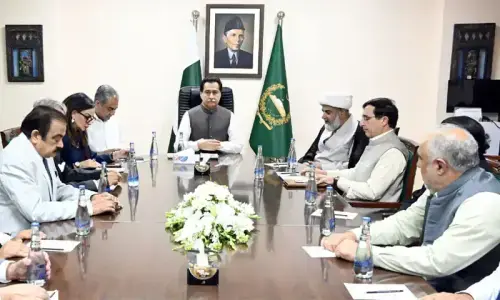
RAWALPINDI: Civil society members on Monday sought repeal of law of evidence (Qanoon-e-Shahadat) and urged the Supreme Court to take notice of its misuse.
They were speaking at a seminar arranged by the Rawalpindi Arts Council (RAC) in collaboration with International Human Rights Association (IHRA).
The basic aim of the seminar was to create awareness of the flaws in the Law of Evidence 1984 as it has affected a large number of people in many cases.
IHRA Chairman Dr Ghazanfer Mehdi said the intervention of the apex court was necessary under the situation where thousands of innocent citizens, especially women were suffering at the hands of blackmailers, he said. Therefore, addressing this issue was vital to ensure the sanctity of the law and justice in the country, he added.
“Such controversial laws should be repealed or amended in a way with a view to removing all flaws,” he said.
He said: “Such laws need to be removed for the revival of original 1973 constitution.”
Mian Javed Anwar Advocate observed that the lacunae in the controversial ‘Qanoon-e-Shahadat’ were resulting in denial of justice and being used by blackmailers against the innocent and law-abiding people of Pakistan, especially the weaker segments of the society including women.
He said that the faulty Articles 46-A & 164 of ‘Qanoon-e-Shahadat’ Order, 1984 should be a matter of immediate attention of the top judiciary keeping in view that the flaws in these articles are grossly being misused.
Syed Ghulam Raza Shah Naqvi explained the phenomenon further and said that the tape-recorded conversations inclusive of privileged relating to private, personal matters such as between the husband-wife, lawyer-client, doctor-patient or relatives, etc.,
should not be made admissible under the law of evidence.
Ch Mazhar Iqbal Advocate said that the larger segment of the public demands that the private, commercial or professional conversations between the parties, if recorded by electronic devices or tape recorder, should not be used as incriminating evidence against each other, so that the private, commercial or professional conversations which are privileged, stand protected from the blackmailers, he added.
Published in Dawn, August 1st, 2017