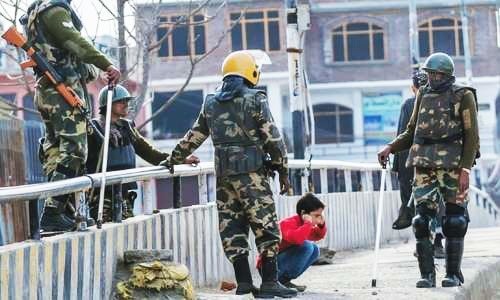
A year ago today, India-held Kashmir was once again forced down the road of political resistance and violent oppression.
With the killing of Burhan Wani in a typically murky operation by Indian security forces, the state of India may have wanted to eliminate a rising symbol of Kashmiri resistance. What it achieved, instead, was the awakening a new generation of Kashmiris.
A year later, India-held Kashmir is in the grip of a sustained resistance movement that is leaderless but radically widespread. The images of young Kashmiri schoolgirls protesting in the streets and hurling rocks at heavily armed Indian security forces are already iconic. They are irrefutable evidence of the abiding resistance of all Kashmiris against the violent Indian rule in IHK.
The government of Prime Minister Narendra Modi may not be in a mood to listen to sensible and compassionate voices in India or to human rights advocates around the world; however, the principled but fierce resistance of the Kashmiris themselves have made at least two things inevitable.
First, the Indian state will have to recognise that there is no path to peace or stability in IHK via violent oppression. Indian propaganda blames the current unrest on either cross-LoC militancy or a small group of IHK young men who have been inspired by Wani to take up arms against India.
But as the images of the stone-throwing schoolgirls have proved, what India is confronted by is a collective resistance by all segments of the Kashmiri population. India is not fighting militancy, but a widespread political consciousness in IHK.
That means eventually the Indian state will have to return to dialogue with the people of IHK; the longer Mr Modi tries to delay the process, the more urgent it will become. Pakistan should do its part by diplomatically highlighting the plight of the people of IHK in countries that have influence with India.
Second, India will have to return to the path of dialogue with Pakistan. Mr Modi and hawkish elements in India have used the unrest in IHK as an excuse to stall dialogue with Pakistan, the claim being that the latter is stirring unrest in the held territory.
But an IHK wracked by unrest and an India-Pakistan relationship that is in deep freeze is a combination that can have dangerously unpredictable consequences, particularly when hardliners in India may be seeking to externalise blame for India’s own mistakes in IHK.
The Kashmir dispute may dominate the bilateral relationship, but there are other areas that need to be the focus of dialogue too. Worryingly, be it India’s collusion with elements hostile to Pakistan in Afghanistan or its attempts to undermine CPEC and Pak-China ties, Delhi seems determined to add to the complexity of the Pak-India relationship rather than keep matters stable.
Mr Modi must recognise what all Indian governments have: dialogue with Pakistan is essential.
Published in Dawn, July 8th, 2017