0
0

ISLAMABAD, Aug 8: The government on Friday informed the World Bank that power tariffs could be reduced considerably by 2005-06 after the country attained sufficient hydro-electric power production capacity.
Sources told Dawn that the visiting Vice- President of the World Bank Mr Praful C. Patel, who held talks with authorities here, was informed that 1,450- MW Ghazi Barotha hydro power project was being inaugurated by President Gen Pervez Musharraf on Aug 19 in this regard.
He was also informed that within the next two years, the project would start full power production, reversing the current ratio of 70:30 thermal power/hydel power generation into 70:30 hydel power/thermal power.
Sources said that Mr Patel, who replaced Ms Mieko Nishimizu, was told that independent power producers were responsible for selling expensive electricity to Wapda, which had financially weakened the power utility over the years.
The situation, they said, would start improving from next year when Wapda would no more be paying upfront payments to IPPs. Wapda’s financial situation was likely to improve in the medium term, given the lower contractual payments to IPPs and the coming on stream of the Ghazi Barotha hydro power project.
The World Bank had supported IPPs in 1994 to have increased profits for selling their electricity to Wapda.
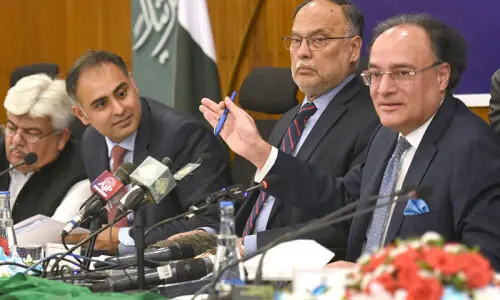
Sources said that Minister for Finance Shaukat Aziz, Minister for Water and Power Aftab Sherpao and Economic Advisor to the Ministry of Finance Dr Ashfaque Hasan Khan assured the World Bank delegation, which also included Bank’s local Chief Mr John Wall, that the government was trying to reduce losses of Wapda and KESC to ensure their timely privatisation.
In this regard, Wapda’s power distribution companies were mentioned for early privatisation, including the Faisalabad Area Electricity Board, which would be disinvested by October.
Sources said the World Bank’s vice-president was also informed that with the financial and technical help of the Asian Development Bank, the Privatisation Commission was trying to disinvest Karachi Electricity Supply Company Limited by December.
Generally, the World Bank and the IMF had been expressing their concerns over the financial health of Wapda and KESC. Both the donors believe that the power sector problems needed to be tackled forcefully, as they have proven to be the main risk to the budget.
Both the donors are of the view that Wapda needs to be made more accountable regarding achievement of the line loss reduction target. The power utility has been asked to reduce line losses to 24 per cent during 2003-04.
Donors also maintain that given Wapda’s resource constraints, it needs to prioritise investments, and refrain from launching new projects.