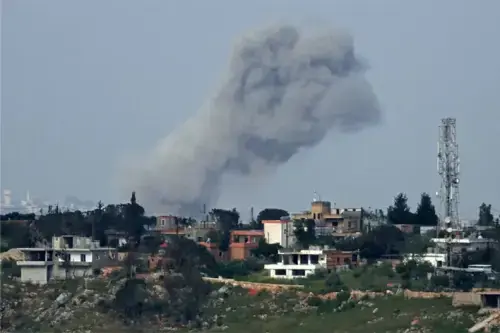
MOSUL: A suicide bomber blew himself up on Friday among civilians fleeing the Old City of Mosul, where increasingly desperate jihadists are mounting a bloody last stand.
The carnage came just over a day after the militant Islamic State group blew up the mosque where its leader Abu Bakr al-Baghdadi proclaimed himself “caliph” three years ago, as well as its iconic ancient leaning minaret.
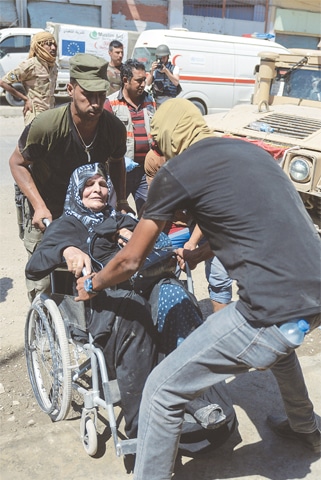
According to a major and medic in the Iraqi army, a bomber who had blended in with fleeing civilians killed at least 12 people in the Mashahda area of the Old City.
“We received 12 people killed and more than 20 wounded in our field hospital, including women and children,” Ahmed Hashem said from a nearby field hospital.
According to Abdelghani al-Assadi, a top commander in the Counter-Terrorism Service that has spearheaded the fighting against IS since 2014, around 8,000 people have managed to flee the Old City since an assault was launched on June 18.
Around 100,000 more are believed to remain trapped by the jihadists, who have made human shields a key element in their defence of old Mosul, their last redoubt in Iraq’s second city.
The security forces have been wary of Iraqi IS members attempting to flee the Old City death trap by blending in with the population, while the Chechen, French and other foreign jihadists stay behind to mount a suicidal last stand.
Omar, his black and grey shirt covered in blood, was one of the more than 20 wounded being treated at the army field hospital following the blast.
“When the security forces started approaching our area, we ran to meet them,” the young man said, nursing a head wound.
Saddam-era army officer likely to replace Baghdadi
If Abu Bakr al-Baghdadi, the leader of the militant Islamic State group, is confirmed dead, he is likely to be succeeded by one of his top two lieutenants, both of whom were army officers under late Iraqi dictator Saddam Hussein.
Experts on Islamist groups see no clear successor but regard Iyad al-Obaidi and Ayad al-Jumaili as the leading contenders, though neither would be likely to assume Baghdadi’s title of “caliph” or overall commander of Muslims.
Russia’s defence ministry said last week Baghdadi may have been killed in an air strike in Syria and Interfax news agency quoted a senior Russian parliamentarian on Friday as saying the likelihood that he had been killed was close to 100 per cent.
But armed groups fighting in the region and US officials say they have no evidence he is dead and many regional officials are sceptical about the reports of his death.
Obaidi, who is in his 50s, has been serving as war minister. Jumaili, who is in his late 40s, is head of the group’s Amniya security agency. In April Iraqi state TV said Jumaili had been killed, but that was not confirmed.
Both joined the Sunni Salafist insurgency in Iraq in 2003, following the US-led invasion which Saddam and empowered Iraq’s Shia majority.
They have been Baghdadi’s top aides since air strikes in 2016 killed his then deputy Abu Ali al-Anbari, his Chechen war minister Abu Omar al-Shishani and his Syrian chief propagandist, Abu Mohammad al-Adnani.
“Jumaili recognises Obaidi as his senior but there is no clear successor and, depending on conditions, it can be either of the two (who succeeds Baghdadi),” said Hisham al-Hashimi, who advises several Middle East governments on IS affairs.
Baghdadi awarded himself the title of caliph — the chief Muslim civil and religious ruler — in 2014. Obaidi or Jumaili would be unlikely to become caliph because they lack religious standing and IS has lost much of its territory.“A caliph has to have an Ardh al-Tamkeen, which he rules in accordance with Islamic law. Failing that, the successor will just be recognised as the emir,” said Hashimi.
Emir is Arabic for prince, and is a title that jihadists often use to describe their leaders.
By contrast, Baghdadi, born as Ibrahim Awad al-Samarrai’ in 1971, comes from a family of preachers and studied Islamic law in Baghdad.
Published in Dawn, June 24th, 2017