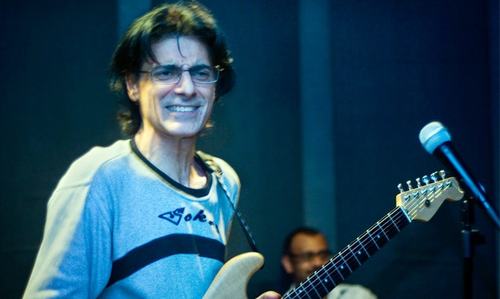
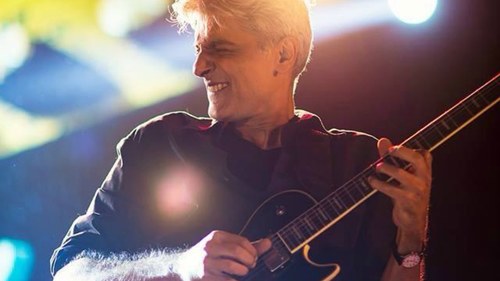
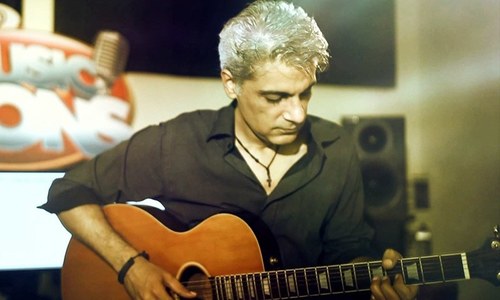
My earliest memory of Aamir Zaki is foggy. But this much I remember: He came to my school when I was very, very young.
He sang Mera Pyaar on an acoustic guitar and I immediately knew what I wanted. I wanted a guitar and I wanted to play like him. How ignorant of me.
Many years later, in 2009-10, I was part of a blues-rock band called Spoonful in college. Someone told us Zaki was looking for some guys to play with. He wanted to start performing again. And that person had told him about my band.
Zaki graciously agreed to come jam with us. He brought a small Roland amp with him, too small to cut through the drums and the large amps we'd piled up in a rather small room at my friend's house.
But Zaki didn't need a large amplifier. He didn't even need any pedals or processors. He just plugged his strat into the small Roland contraption and blew our minds.
In consequent jam sessions, we arranged for a bigger Fender amplifier for him. He would gleefully turn it all the way up. We all probably lost a bit of our hearing in those jams. Just as well. We may never ever hear something like that again. I will certainly never hear another guitar player like him.
There's so much that will be written about him in the coming days. About his ability to serve the song, to let it rip when he wanted to. He was Pakistan's greatest guitar hero, our Jimi Hendrix, our Stevie Ray, our troubled, enigmatic rockstar.

My band and I saw his demons too. We knew he was a misplaced genius. He refused to compromise on his music and self even when he fell on hard times.
We could tell that his famous friends were wary of his eccentricities. They wanted someone reliable, someone who fit the mould of the corporate-sponsored cupcake that mainstream music had become.
I’m glad he eventually featured in Coke Studio. But when I saw him sitting there playing a humbucker guitar as opposed to the shrieking single-coil strat he loved, poker-faced, unsmiling, I knew he wasn’t really there. He didn’t deserve to be either.
He deserved to tour the world, to record dozens of incredible albums like Signature. I knew he had these songs in him that he couldn’t wait for the world to hear. We were privileged to hear them, unaffected by the glam of the stage, at my friend’s house.
We would be in awe of his ability, even when he would be lecturing us on the lack of our own. But he never really put us down. He never told me how bad a player I was. On the contrary, he gave me one of his guitars. Just like that.
We were driving back home from a gig and he asked me if I liked the guitar. I told him I thought it was great and he just handed it to me. "Keep it". He later joked how he would not sign it because I’d sell it for a fortune after he died. How ignorant of him.
What is your memory of Aamir Zaki? Tell us at blog@dawn.com

The writer is a desk editor at Herald.