‘Not the first time Afghan forces have attacked civilians’



QUETTA: Relatives of those caught in a cross-border fire between Afghan and Pakistan forces near the border town of Chaman were not amused to find a journalist in their midst. “Buzz off!” cried the attendant of a patient brought to the trauma centre of the Sandeman Provincial Hospital in Quetta. “We do not want to speak to media people.”
I backed off, mortified by the exchange, but one of the relatives of a patient shot in Killi Luqman, near Chaman, waved me over. “Yes. Our patient Noor Mohammad Achakzai was injured in the attack...he was hit by machine gun fire at four o’clock, while we all were asleep,” said Rehmatullah Achakzai, a cousin of Noor Mohammad.
The victim, who was in his late thirties, lay shrieking in pain from the gun wounds he had suffered. Noor Mohammad’s uncle turned to me with a grave expression: “The war has started...it [is] between Pakistan and Afghanistan.”
There were four patients from Chaman being treated at the trauma centre of the hospital while the rest of the victims were undergoing surgery there. Another hospital, the Bolan Medical Complex on Brewery Road, situated on western side of the city, had taken in the remaining victims who had suffered gun wounds in the attack.
Two children were being operated on at the Sandeman Provincial Hospital. One of them was Allahuddin Achakzai, aged 12 years.
His brother Nasir Achakzai stood in front of the operating theatre at the trauma centre, puffing a cigarette and looking thoroughly confused as he shared the story of how his brother had landed there: “I was in a deep sleep at around dawn in my village Bagh Chah, which is two kilometres away from border. When the firing began on our village, we all woke up to the news of my brother getting shot in the thigh. We went up to the mountains, along with Allahuddin, to save our lives. Besides Allahuddin, a bullet had also pierced my cousin’s arm.”
The drive from Chaman to Quetta takes around three hours, and perhaps that is why a lot of the patients’ lives could be saved. At the time of filing this story, the Chaman Civil Hospital’s medical superintendent had confirmed: “So far, nine civilians have been killed in the cross-border firing, while 43 of them are injured. Those whose conditions were critical were referred to Quetta.”
Besides Torkham, Chaman is Pakistan’s official border crossing with neighbouring Spin Boldak in the Kandahar province of Afghanistan. It is mostly members of the Pashtun Achakzai tribe that live along the border, so most of the victims were from the tribe.
Sources told Dawn, “Three days ago, when coordination was carried out through diplomatic and military channels, the Afghan authorities had warned that they would not let [officials] conduct census in towns bordering Afghanistan.”
According to the Qilla Abdullah district commissioner, at the beginning, two civilians, a man and a woman, were killed because of the firing, but five others were killed later due to [the heavy] shelling.
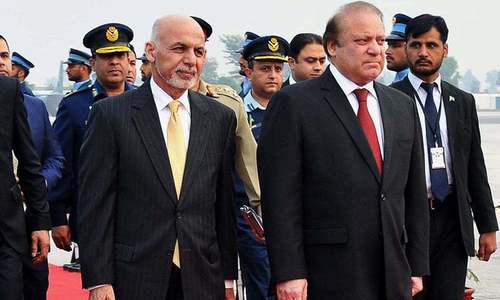
Last week, while returning from a two-day official visit to Afghanistan, National Assembly Speaker Ayaz Sadiq had waxed lyrical about a frank “heart-to-heart” meeting with Afghan President Ashraf Ghani that had apparently gone on for over five hours.
Shahzada Zulfiqar, a senior Quetta-based journalist, says: “The incident in Chaman has further strained ties between Pakistan and Afghanistan. The reason is that Afghan President Ashraf Ghani had refused to visit Pakistan. On the other hand, Pakistan and Afghanistan were complaining about each other or, to be more specific, accusing each other of [stirring] trouble by allowing [miscreants] in each other’s countries.”
From his office on Jinnah Road, senior analyst Jalal Noorzai said, “Ever since the formation of the [current] Afghan government, following the US invasion of Afghanistan, it has [fuelled] anti-Pakistan [sentiments].”
As for the incident on the Chaman border, he opined, “It should be noted that Afghan forces have not attacked civilians for the first time. In the 1980s, these kinds of attacks could be seen along the border region.”
Published in Dawn, May 06th, 2017