0
0

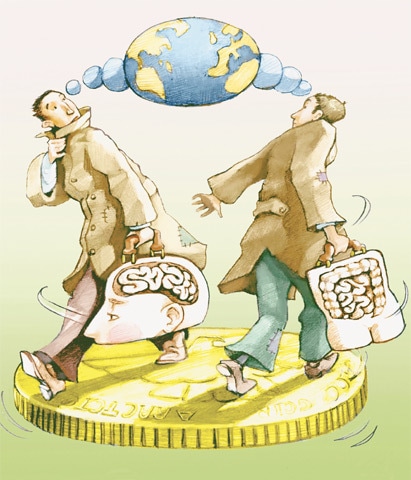
The success that the current phase of globalisation engineered for giant banks and big corporations perked up at the commanding height of economies under different stages of development, led many scholars and policymakers to conclude that nationalism and protectionism had entered the twilight zone.
The unprecedented movement of capital, goods and manpower across national boundaries, the emergence of a huge middle class and sharp cuts in poverty worldwide were seen as the handiwork of West-led globalisation and globalisation alone.
The dynamics of transforming developing economies and emerging markets — from agrarian to semi-industrial— in boosting prosperity and reducing poverty was ignored. It was also forgotten (to borrow a phrase from a UK publication) that “global interests compete with national interests.”
Globalisation has a future but it needs to chart a new course to build a more balanced and equitable economic order
Chinese policies designed to build national champions have narrowed the space for foreign companies, says American Chamber of Commerce in China.
The self-assertion by nation-states was often managed by regime changes, bringing them into the international mainstream. The majority compromised their economic sovereignty to leverage their traditional ties with the West to industrialise faster with the help of foreign capital, technology and expertise. This helped developing states and emerging markets to acquire industrial muscle and spurred their urge for self-determination; reminding many Western thinkers of narrow nationalism and ‘a dog-eat-dog world’ whose age, they thought, is past.
While developed economies had entered the post-industrial era decades earlier the developing countries were still, largely grappling with an industrialising world. In this process the less developed economies, or nation-states were dwarfed by the bulging size and reach of global markets and giant corporations; more significantly, they developed structural imbalances. After all globalisation had lately been driven by debts, subsidies, competing currency depreciation and abnormally low interest rates.
The countries placed on the periphery needed space to re-balance their economies — a problem that free markets did not address convincingly. This contributed to selective protectionism.
But advocates of globalisation were in for a shock when nationalism and protectionism emerged from the most unexpected quarters. The West’s bastions of free markets and the most advanced model of regional cooperation was hit by the ‘lack of confidence’ expressed by common voters in the British referendum and the US national polls. It marked the triumph of citizen- based democracy over market democracy. This was not about citizens choosing one political party or another but an issue of rejecting a dominant system.
These developments mark the beginning of an era in which struggle for self-determination between and within nations will forge a different framework for international economic cooperation which is required to create a new economic order.
Here it may be pertinent to recall an observation by British Prime Minister Theresa May: “If you believe you are a citizen of the world, you are a citizen of nowhere. You do not understand what the word citizenship means.” And American President Trump says that his administration “would no longer surrender the country or its people to a false song of globalisation.”
The views of the common citizen were shaped by a strong perception that inequality between the rich and poor, between and within nation-states, was widening; that temporary and low paid jobs were turning into a new norm, replacing permanent employment and lifetime careers. Even for most talented experts, a bight career needed to be shepherded by hopping jobs.
In the wake concerns on rising immigration, Australia has announced that it will scrap temporary visa for skilled overseas workers to give priority to to its own nationals for local jobs.
But western thinkers are now talking about ‘new nationalism’ and ‘enlightened patriotism’ while upholding ‘civic nationalism’ demonstrated during major sport events, but rejecting ‘ethic nationalism’. This is what the London Economist pleads in a recent editorial.
Enlightened patriotism needs to be defined and elaborated to make it work in a chaotic world even though some of its features are already visible on the global arena. The Chinese are staunch nationalists but they have not shunned globalisation.
The narrow, chauvinistic Hindu nationalism with hegemonic overtones has been a barrier to regional cooperation in South Asia but New Delhi is still strongly committed to globalisation. This has not deterred the Indian government from erecting tariff barriers to protect its domestic industry from outside competition wherever thought advisable. In Pakistan the import policy is being tailored to reverse de-industrialisation.
It is a multilayered international cooperation in the community of nations that is perhaps more suitable than the zeal for a unified single market, though key central ideas, now emerging, may still ultimately shape world economic order.
Historical record shows that globalisation has assumed various forms and shapes over the centuries. In medieval times, empire builders were great pioneers of globalisation. Later captive markets provided raw materials and served as market for finished goods produced by colonial, industrialised countries. After the demise of colonialism, international financial markets took up the baton or the mission of West-led globalisation.
Given a different economic scenario emerging after the Great Recession of 2007-08 protectionism has become inevitable to counter the adverse affects on national economies of the erratic and volatile global markets. Globalisation has a future but it needs to chart a new course to build a more balanced and equitable economic order.
Published in Dawn, Business & Finance weekly, April 24th, 2017